
What Is Lead Generation for Local Businesses?
Lead generation defined for CT small businesses: leads vs traffic, the capture-to-customer path, channels, and what a 'qualified lead' actually means.

When clients ask us what is lead generation for small business, we hear the phrase used loosely in the marketing space every single day. Some agencies use it to describe mere website traffic. Others use it to mean random inbox volume or purchased email lists.
Our team prefers a much stricter definition based on actual buying intent.
The distinction between a casual visitor and a genuine prospect changes everything. This guide breaks down what a highly tuned lead generation system looks like for a Hartford County local service provider. We will explore the exact data, explain what it means, and show you where most setups break.
A Lead vs a Visit
A visit is simply someone who landed on your website, saw your Google Business Profile, or clicked an ad. A lead is a person who took a specific action signaling clear buying intent. We categorize several distinct activities as true leads:
- Submitting a quote form
- Calling the office directly
- Booking a consultation calendar slot
- Starting a live web chat
Most local websites convert between 1% and 4% of total visitors into inquiries. A 2026 industry benchmark report by Lucky Orange shows that focused landing pages can push that to 5% or higher. Our most successful campaigns for Connecticut service businesses routinely hit the 3% to 8% range.
High-intent categories like emergency roofing naturally convert at the top of that scale. Meta instant lead forms often outperform general website traffic campaigns for capturing local intent.
The 4-Stage Path
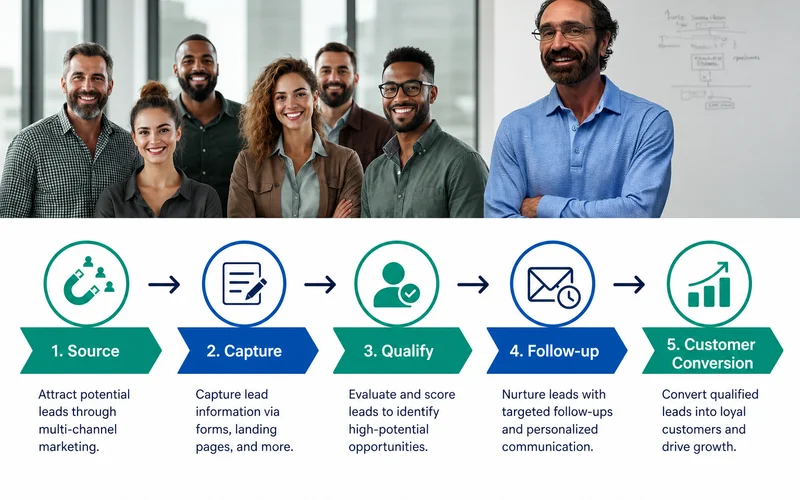
We track every prospect through the exact same four-stage path. The journey starts and ends with predictable steps. Each phase requires a different strategy.
- Awareness: A person hears about the business via search, referrals, or an ad.
- Inquiry: They take action by submitting a form or calling.
- Qualified: The prospect matches the required service area, budget, and timing.
- Customer: They sign a contract and buy.
Our analysts multiply the conversion rate of each stage together to reveal the true cost-per-customer. Many small businesses optimize heavily for the first stage by chasing more traffic. They completely ignore the massive leverage hidden in the later stages.
We see companies drop the ball during the qualification and follow-up phases. A CRM tool like GoHighLevel can automate those critical middle steps. Focusing further down the funnel fixes the biggest leaks in the system.
Where Local Business Leads Come From
We always encourage clients to build a diverse mix of lead sources. Relying on a single channel creates massive vulnerability. A sudden algorithm update or a suspended Yelp account can pause business overnight.
Our data shows a highly predictable volume breakdown for Connecticut small businesses. The realistic spread looks like this:
- Google Business Profile: This drives 30% to 50% of leads through direct calls and website clicks.
- Organic search: A well-ranking website generates 20% to 40% of inquiries for specific service queries.
- Referrals: Past customers and professional networks usually provide 15% to 30%.
- Paid ads: Google Ads and Facebook contribute up to 30%, depending entirely on the budget.
- Social media: General organic social posts drive under 10% for most local services.
Recent 2026 data from BrightLocal shows that 46% of all Google searches carry local intent. We use this statistic to prioritize Google Business Profile optimization above almost everything else. A staggering 76% of those local searchers contact a business within 24 hours. This platform sits directly at the decision point for ready buyers.
We assure our clients that diversifying across three or more of these sources builds true stability.
What Makes a “Qualified” Lead
A qualified lead must match the business in three critical dimensions. Volume means nothing if the caller needs a service you do not provide. We focus on filtering prospects quickly without causing friction.
The ideal prospect aligns with your offerings, geography, and timing.
| Qualification Dimension | What It Means | Why It Matters |
|---|---|---|
| Fit | The specific services you actually provide. | Prevents wasted hours quoting unprofitable jobs. |
| Geography | The physical location is within your service area. | Eliminates excessive travel time and routing issues. |
| Timing | The prospect is ready to buy in your typical timeframe. | Separates urgent buyers from casual window shoppers. |
A good intake form filters these criteria in under 60 seconds. We implement three short qualifying questions to accomplish this goal perfectly. Dynamic forms like Typeform or Meta instant forms easily capture what, where, and when. Keeping the friction low prevents scaring off great prospects.
We track how this simple filter saves our teams hours of wasted sales calls every week.
Cost Per Lead vs Cost Per Customer
Cost per lead is incredibly easy to measure but highly misleading on its own. The formula simply divides total spend by the number of leads generated. We urge business owners to look past this vanity metric.
Cost per customer reveals the true financial health of a campaign. This real metric divides total spend by the number of actual paying customers. We see companies fail because they optimize for cheap inquiries instead of closed deals.
A $40 lead with a 50% close rate produces an $80 customer acquisition cost. A cheaper $20 lead with a 10% close rate produces a painful $200 acquisition cost. We prefer to track both numbers carefully every month.
According to 2026 data from Zio Advertising, exclusive Google Local Services leads often close at 25% to 35%. Shared leads from third-party platforms typically close at a dismal 5% to 15%. We focus on driving the final cost per customer down instead of just celebrating cheap leads.
The Speed-to-Lead Multiplier
Inquiries that receive a response in under five minutes convert roughly eight times better than 30-minute responses. This speed gap is the highest-leverage variable in most sales systems. We consider this the most commonly ignored metric in local business marketing.
Recent 2026 data from LeanData shows the average B2B company takes 42 hours to respond to a new lead. A Harvard Business Review study confirms that 78% of customers buy from whichever business responds first. We solve this problem for busy teams by deploying simple automation tools.
An owner cannot always answer the phone while on a job site. The fix involves setting up specific tools:
- Instant auto-replies via SMS
- Automated email confirmations
We install missed-call text-back features to catch every unanswered ring. AI receptionist tools like NextPhone or AINORA can handle after-hours conversations effortlessly. These software solutions close the response gap automatically while the team works. We watch these cheap tools pay for themselves within the first week of use.
What a Real Lead Generation System Looks Like
Most small businesses have the first two parts of their marketing partially functional. They completely skip the critical follow-up and tracking phases. We see owners wonder why volume stays flat despite spending more on ads.
A full system for a Hartford County small business requires four distinct parts working together.
- Traffic: This includes local SEO for the long term, Google Ads for short-term levers, Google Business Profile, and referrals.
- Conversion: The setup requires a tuned website, clear calls to action, mobile-first forms, and click-to-call buttons.
- Follow-up: The process demands instant auto-replies, missed-call text-backs, and an AI receptionist.
- Tracking: Every inquiry must be tagged by source using tools like CallRail to measure costs monthly.
The most sophisticated companies operate within an integrated growth ecosystem. We connect high-intent capture engines directly into a CRM like ServiceTitan or GoHighLevel. Automated follow-ups nurture the relationship immediately. Ongoing SEO efforts build organic authority to reduce reliance on paid ads.
We build these exact systems to ensure no opportunity falls through the cracks.
Why “Buying Leads” Underperforms
Lead marketplaces like Angi, HomeAdvisor, and Thumbtack sell the exact same prospect to three or five different competitors. The resulting race forces contractors to call first and quote the lowest price. We watch excellent service providers lose jobs simply because they lacked an aggressive sales script.
Shared platforms create a stressful race to the bottom for pricing. Owned leads from a dedicated website or Google Business Profile convert three to five times better than shared inquiries. We calculate that a $75 exclusive lead closing at 35% is mathematically cheaper than a $25 shared lead closing at 10%.
The math on owned assets compounds heavily over six to twelve months. As local SEO matures, the cost per acquisition drops significantly. We strongly advise clients to invest in their own digital real estate rather than renting shared data.
The Simple Audit
Evaluating a current setup answers the core question of what is lead gen for your specific market. Finding the broken links in the chain reveals exactly where to focus next. We run new clients through a straightforward five-question audit to spot the leaks.
You need to know whether the small business lead generation system is actually working. Ask these specific questions about last month’s performance:
- How many inquiries did you get last month from each specific source?
- What was the exact cost per lead on each of those channels?
- How fast did the team respond to the average inquiry?
- What was the final close rate for those conversations?
- What was the ultimate cost to acquire a paying customer?
We find that most business owners cannot answer at least two of these questions. A blank answer instantly highlights the exact place to start fixing the business. Tracking platforms like CallRail or simple CRM dashboards provide these numbers clearly.
We recommend setting up basic tracking today to master lead generation basics and stop guessing about tomorrow’s revenue. This process defines exactly what is lead generation for small business when executed properly. Focus on the data, follow up instantly, and watch the calendar fill up.
We see this data-driven approach transform local service companies into market leaders.
Frequently Asked Questions
Is more traffic the same as more leads?
No — traffic is the top of the funnel. Without conversion paths (forms, calls, chat), traffic walks away. Most small businesses need conversion fixes, not more traffic. A site with 200 visitors and good conversion beats one with 2,000 visitors and bad conversion.
What's a 'qualified lead'?
A lead that matches your service area, budget range, and timing. Filtering disqualified leads up front saves hours of follow-up. Good lead forms ask 2-3 qualifying questions that filter automatically.
How fast should I follow up with a lead?
Under 5 minutes when possible — conversion rates drop sharply after the first hour. Automation makes this feasible without staffing. Auto-replies hold the lead until you can respond personally.
Related Service
Learn more about Lead Generation
See how Fly Spectra delivers lead generation for Connecticut small businesses — flat-fee, fast, and direct with the owner.
Explore Lead GenerationRelated Guides
How Fast Should You Respond to a New Lead?
The 5-minute response rule explained: why leads go cold fast, what missed-call text-back recovers, and how to build a system that beats human reaction.
How to Choose a Lead Generation Partner in Connecticut
Owned leads vs rented leads, transparency and reporting, who owns the assets, realistic expectations. The 7-question checklist for hiring a partner.
Lead Generation for Connecticut Contractors & Home Service Businesses
A real lead system for CT trades: quote-request flows, fast follow-up, seasonal demand, filtering tire-kickers. No shared leads — only ones you own.
SEO Leads vs Paid Ad Leads vs Bought Leads: Which Pays Off?
Comparison of 3 lead sources for CT businesses: SEO (compounding), paid ads (flat cost), bought leads (shared and cheap-feeling). Cost, quality, durability.
Have a question this guide didn't answer?
Send a quick message. Joseph replies personally, usually the same day.