
Lead Generation for Connecticut Contractors & Home Service Businesses
A real lead system for CT trades: quote-request flows, fast follow-up, seasonal demand, filtering tire-kickers. No shared leads — only ones you own.

We see the same pattern across the Connecticut home services industry, where closing jobs depends entirely on speed and local relevance.
Those outdated lead generation for contractors strategies just bleed money today.
Let’s look at the data, what it actually tells us, and explore practical ways to fix your pipeline.
The Realistic Lead Mix for CT Trades
We typically aim for a balanced approach to avoid single-channel failure. A healthy Hartford County contractor should look at specific 2026 distribution models.
BrightLocal’s 2026 Local Consumer Review Survey shows that 45% of consumers now use AI tools for local business recommendations. Our team uses this exact target distribution for regional service businesses:
- Google Business Profile (phone calls + direction requests): 30% to 45%
- Organic search (your service-area pages + your services): 20% to 35%
- Referrals (past clients, network): 15% to 30%
- Paid ads (Google Ads): 0% to 25% depending on budget
- Shared lead marketplaces (HomeAdvisor, Angi): 0% to 15% with caveats
Sudden Google algorithm shifts can destroy businesses that rely on a single source for more than 50% of their jobs. That dangerous concentration leaves you completely vulnerable to market changes.
Our constant advice is to diversify your pipeline to keep the phone ringing year-round.
Why Shared Leads Underperform for Trades
Profitability often drops massively when companies rely exclusively on shared directories. Platforms like HomeAdvisor and Angi sell the exact same customer information to up to five local competitors simultaneously.
We note that the LeadTruffle 2026 guide shows these networks now carry a 90% negative sentiment rate among trade professionals. This shared model predictably creates a desperate race to the bottom on price. Customers get frustrated with five calls in ten minutes, which produces these poor metrics:
- Low close rates (typically 5% to 15% vs 30% to 50% on owned leads)
- Lower job value (customers shop strictly on price)
- Lower lifetime value (no relationship, strictly transactional)
- High refund and dispute rates (frequent no-shows and bad fits)
Our team calculates that paying $50 for a shared lead with a 10% close rate actually means spending $500 per booked job. Owned leads from a dedicated local website usually run just $40 to $80 per customer.
Those distinct profit margins are impossible to ignore. We recommend using shared directories only as a short-term bridge while your owned lead generation system builds momentum.
Building those owned digital assets immediately must become your top priority. Serious local businesses need a better way to filter potential buyers.
Quote-Request Flow That Filters
Our developers highly recommend replacing generic contact pages with targeted quote flows. The standard contractor form usually attracts a massive amount of unqualified tire-kickers.
Tools like Jobber or Typeform allow you to build an automated qualification process right into your website. We help top-performing clients use a specific sequence to filter out bad fits instantly. A real quote-request flow filters automatically with these five quick questions:
- What service do you need? (dropdown with your top 5-10 services)
- Where is the job located? (dropdown of your Connecticut service area towns)
- When do you need it done? (this week, this month, or planning ahead)
- Brief description of the job (simple text field)
- Best way to reach you and best time (phone, text, or email, with a time window)
Serious customers complete this digital format in 60 to 90 seconds. Our data shows unqualified prospects drop off before wasting your precious time.
This automated setup gives you pre-qualified inquiries with enough context to prioritize immediate callbacks. Fast responses are the absolute key to locking down these qualified deals.
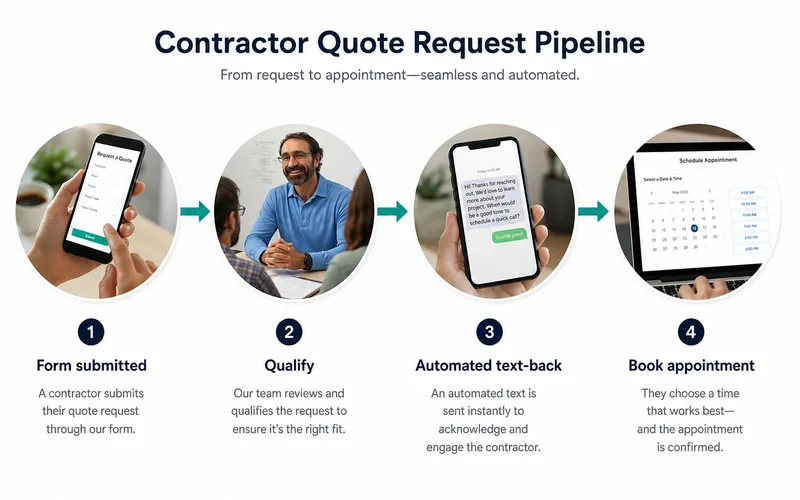
Speed-to-Lead Is the Multiplier
We consider rapid response times to be the biggest revenue driver in the trades. A massive Harvard Business Review study shows companies responding to leads within five minutes are 100 times more likely to make contact than those waiting 30 minutes.
The Hatch 2024 analysis found that 88% of home services users still take longer than five minutes to reply. Our strategy centers entirely on beating that expensive industry delay.
The 5-Minute Conversion Window
Contractors who answer web inquiries immediately close seven to nine times better than competitors who wait an hour. The customer remains exactly the same, but the fastest business wins their trust.
We know most Connecticut tradespeople cannot sit by a desk phone all day. This specific automation stack bridges that critical gap effortlessly:
- Instant SMS auto-reply on every single form submission
- Missed-call text-back on every unanswered call
- AI receptionist software for after-hours and overflow calls
- Automated email routing to send formatted lead details straight to your crew
Simple software systems like GoHighLevel generally cost under $200 per month combined. Our clients find that this tiny investment pays for itself during the very first recovered job.
Your business gains a massive advantage simply by being the first voice on the line. These tools act as the most reliable digital employees you could ever hire.
Seasonal Demand Patterns
We map out marketing calendars based entirely on local weather cycles. Connecticut trade businesses experience very predictable spikes in search volume as seasons shift.
Waiting until it snows in Stamford to start advertising plowing services is simply too late. Our data confirms that preemptive campaigns yield the cheapest trade leads Connecticut has to offer. Here are the standard seasonal curves for regional contractors:
| Trade | Peak Months | Off-Season |
|---|---|---|
| HVAC | May to Sept (AC), Oct to Nov (heating) | Jan to Feb |
| Roofing | May to Oct | Dec to Feb |
| Landscaping | Apr to Oct | Nov to Mar |
| Painting (exterior) | Apr to Oct | Nov to Mar |
| Plumbing | Year-round, slight spike in winter | Not applicable |
| Snow/plowing | Nov to Mar | Apr to Oct |
Early preparation makes a massive difference in final profit margins. We tell every partner to launch their SEO and content pushes six to eight weeks before these peak windows.
Google requires serious lead time to crawl, index, and rank new service pages. Pre-summer AC repair content published in March captures significantly more traffic than reactive content posted in July.
Our most successful clients finalize their summer advertising budgets during the winter slump. Those proactive habits prevent empty schedules when the busy season finally hits. Poor technical setups can still ruin these perfectly timed advertising campaigns.
Where Trade Websites Lose Leads
We audit hundreds of local websites and find the same massive leaks every single time. A site might look beautiful but completely fail to generate actual phone calls.
Recent 2026 data from Elementor shows that a mere one-second delay in mobile page load times reduces conversion rates by up to 20%. Our technical teams focus on fixing three specific conversion killers immediately. Here are the most common patterns destroying your potential pipeline:
- No service-area landing pages. A contractor serving eight towns with one generic “Service Areas” page ranks for absolutely none of them. One highly optimized landing page for each primary town fixes this visibility issue.
- Hidden phone numbers on mobile devices. Mobile users want to call right away. If your phone number is not a tap-to-call button above the fold, those potential jobs vanish.
- Bloated and complex forms. Contact forms demanding 12 different details cut your conversion rates in half. Limiting your questions to three or five essential fields creates a much smoother experience.
These basic structural errors hand your best prospects directly to faster competitors. We always prioritize mobile speed alongside these necessary page modifications.
A whopping 53% of mobile users will abandon your site entirely if it takes longer than three seconds to load. Initial technical audits often double a company’s incoming volume just by repairing these simple flaws.
Our next focus always turns to tracking the exact source of that incoming volume. Proper attribution prevents wasted spending on ineffective digital campaigns. Guessing where your best customers originate is a guaranteed way to drain your budget.
Tracking What Works
We insist that every single marketing dollar must be tracked back to a closed job. Specialized tracking software like CallRail or Google Analytics 4 provides total clarity on your marketing performance.
Clear attribution shows exactly which platforms generate the highest returns. Our standard protocol requires tagging every inbound inquiry by its specific traffic source. You must monitor these minimum monthly metrics to stay profitable:
- Total raw leads generated
- Leads categorized by traffic source
- Qualified leads matching your location and timing criteria
- Your actual sales close rate
- Average booked job value
- Cost per lead separated by source
- Total cost per acquired customer
This specific tracking setup eliminates all the guesswork from your daily operations. We notice a massive shift when Connecticut trade companies finally measure these exact data points.
They quickly realize that their Google Business Profile and local organic traffic produce the cheapest, most lucrative jobs. This realization prompts them to stop throwing cash into highly competitive, shared marketplaces.
Our clients routinely double their return on investment simply by reallocating funds to the channels that actually convert. This financial clarity completely transforms how local businesses approach their growth strategies. Understanding the true cost of these comprehensive systems is the final crucial step.
What a Real Program Costs
We believe in full financial transparency when building these digital engines. Upgrading your contractor lead generation setup requires a targeted, highly realistic operating budget.
A comprehensive 2026 Ahrefs industry survey shows most successful local businesses invest between $1,000 and $2,500 monthly for effective regional marketing. Our pricing models reflect these exact market realities for a typical Connecticut service company. Here is what a professional system actually costs to implement properly:
- Website conversion fixes ($500 to $2,500 one-time fee): Adds a massive 30% to 50% increase to your existing traffic lead volume.
- Local SEO program ($600 to $1,200 per month): Compounds organic ranking and Google Business Profile calls over three to six months.
- Lead automation tools ($150 to $400 per month): Covers missed-call text-back features, AI receptionists, and instant auto-replies.
- Total ongoing investment: $750 to $1,600 per month for a completely optimized sales machine.
Upgrading your technical foundation pays compounding dividends for many years to come. We see most operators recover this entire monthly expense with just two to four new booked jobs.
Those extra jobs would never have materialized without faster response times and dominant local search visibility. Making your business the absolute easiest choice for any local homeowner guarantees long-term stability. Our main goal is to build you an asset that generates revenue while you sleep.
Ready to Fix Your Pipeline?
Taking control of your online presence requires deliberate, sustained technical effort. You do not have to figure out these complex digital systems entirely on your own.
We know that mastering home service leads CT businesses need takes serious dedication. Implementing even one of these basic automation strategies will immediately improve your local closing rates.
Small, consistent improvements create massive advantages over slower regional competitors. Our team is ready to audit your current setup and find those hidden revenue leaks today.
Frequently Asked Questions
Are shared leads (HomeAdvisor, Angi) worth it?
Rarely worth it long-term — same lead sold to 3-4 competitors, race to the bottom on price. Owned leads from your own site convert far better. Use shared leads only as a short-term bridge while owned lead generation compounds.
How can I filter out tire-kicker quote requests?
Add 2-3 qualifying questions to the form (job type, timeline, budget range). Filters automatically and signals serious intent. Tire-kickers usually drop off when forced to provide specifics; serious customers don't mind.
What's the best lead source for CT contractors?
Google Business Profile + service-area website pages produce the highest-converting leads. Referrals from happy past clients are #1 but harder to scale. Together, GBP + organic + referrals can produce 80%+ of monthly lead volume.
Related Service
Learn more about Lead Generation
See how Fly Spectra delivers lead generation for Connecticut small businesses — flat-fee, fast, and direct with the owner.
Explore Lead GenerationRelated Guides
How Fast Should You Respond to a New Lead?
The 5-minute response rule explained: why leads go cold fast, what missed-call text-back recovers, and how to build a system that beats human reaction.
How to Choose a Lead Generation Partner in Connecticut
Owned leads vs rented leads, transparency and reporting, who owns the assets, realistic expectations. The 7-question checklist for hiring a partner.
SEO Leads vs Paid Ad Leads vs Bought Leads: Which Pays Off?
Comparison of 3 lead sources for CT businesses: SEO (compounding), paid ads (flat cost), bought leads (shared and cheap-feeling). Cost, quality, durability.
What Is Lead Generation for Local Businesses?
Lead generation defined for CT small businesses: leads vs traffic, the capture-to-customer path, channels, and what a 'qualified lead' actually means.
Have a question this guide didn't answer?
Send a quick message. Joseph replies personally, usually the same day.