
SEO Leads vs Paid Ad Leads vs Bought Leads
Comparison of 3 lead sources for CT businesses: SEO (compounding), paid ads (flat cost), bought leads (shared and cheap-feeling). Cost, quality, durability.
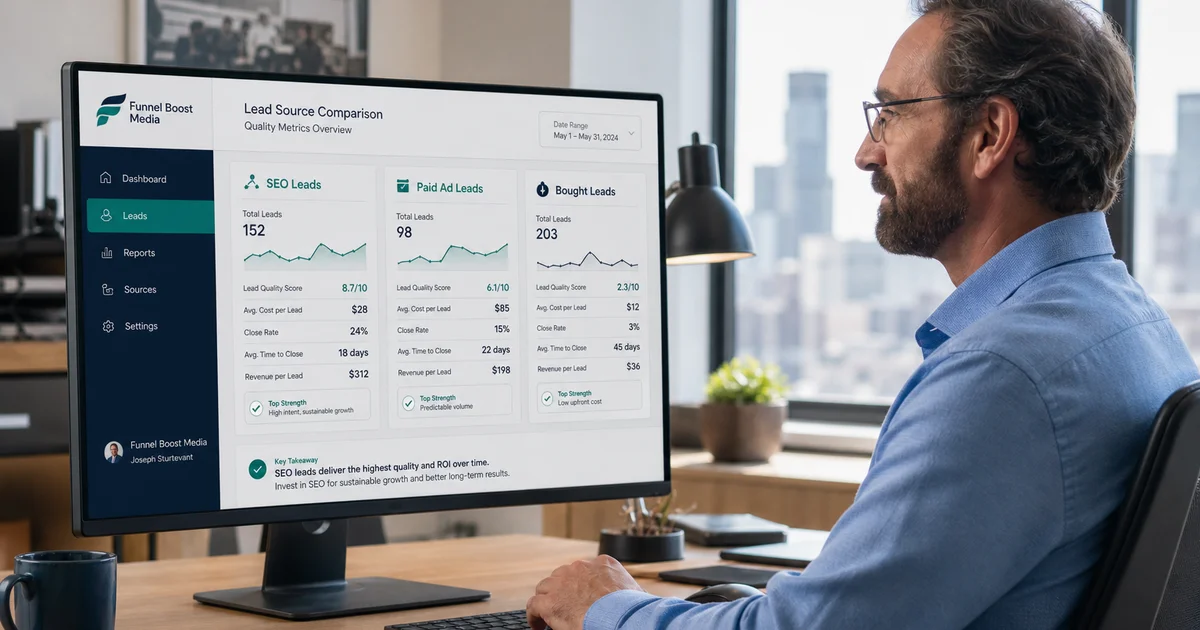
We know how frustrating it is to pour money into marketing without knowing your true return on investment.
Most US businesses rely on a scattered mix of lead sources. The real challenge is identifying which channels actually drive profitable growth. Our lead generation team has analyzed these exact patterns across hundreds of campaigns.
This data reveals a stark contrast between owned assets and rented traffic. Every dollar spent needs to work harder than ever this year.
We are going to look at the direct comparison of seo leads vs paid leads, along with shared inquiries. Then, this guide will walk through the exact budget frameworks you can use to make a confident decision.
The Three Categories
The three main categories of lead generation are organic traffic, paid advertising, and shared marketplace inquiries. Each channel requires a distinct strategy to turn a casual searcher into a paying client.
- 1. SEO/Organic Leads: Visitors find your business through Google search, your Google Business Profile listing, or local directories. These high-intent inquiries are generated by an effective local SEO investment and helpful on-page content. Our tracking shows that organic visibility builds a permanent asset for your brand.
- 2. Paid Ad Leads: Homeowners and business owners click your Google Ads, Facebook Ads, or other sponsored placements. This method requires ongoing ad spend and stops the moment your budget runs out. A 2026 WordStream benchmark report found that Google Ads now average a $70.11 cost per lead across all US industries.
- 3. Bought/Shared Leads: Inquiries are delivered through marketplaces like HomeAdvisor, Angi, Thumbtack, or category-specific platforms. You pay a set fee per contact, but the exact same inquiry usually goes to three to five competitors simultaneously.
The Headline Comparison Table
A clear lead source comparison reveals that shared inquiries appear cheap upfront but become the most expensive way to acquire a customer. Search engine optimization feels slow initially but compounds into your most affordable asset.
We compiled this data to give you a realistic look at the numbers. The cost differences become massive when you look past the initial click and measure the actual closed jobs.
| Factor | SEO Leads | Paid Ad Leads | Bought Leads |
|---|---|---|---|
| Speed to first lead | 3-6 months | Days | Days |
| Cost per lead (year 1) | $40-$100 | $50-$200 | $25-$60 |
| Cost per lead (year 2+) | $15-$50 | Same as year 1 | Same as year 1 |
| Lead exclusivity | 100% yours | 100% yours | Shared 3-5 ways |
| Close rate | 25-50% | 15-35% | 5-15% |
| Cost per customer | $80-$200 | $150-$500 | $200-$600 |
| Durability | Compounds | Stops with payment | Stops with payment |
| Quality | High | Variable | Low to medium |
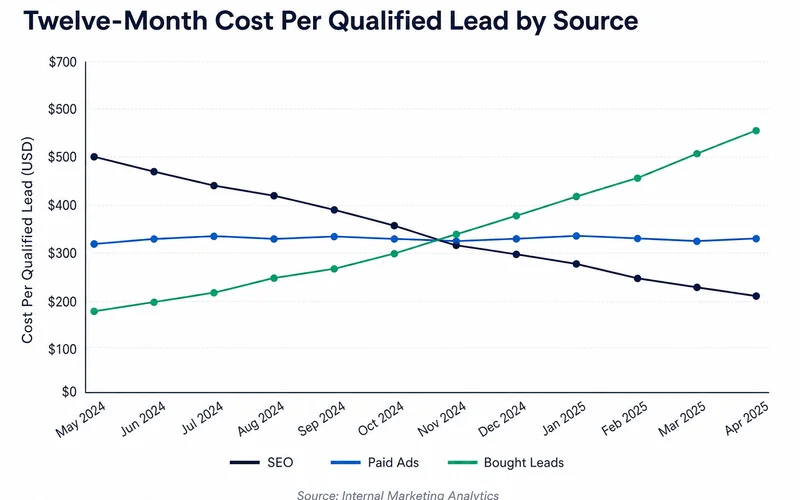
The headline takeaway is clear. Bought leads look cheapest on the surface but create the highest customer acquisition costs. SEO requires patience in the first quarter but drops significantly in price by year two.
Why Bought Leads Underperform
Bought leads consistently underperform because you are paying to enter a bidding war against multiple desperate competitors. Shared lead marketplaces sell the exact same inquiry to several local contractors at once.
The customer gets four or five calls within ten minutes and quickly becomes annoyed. The conversation immediately turns into a race to offer the most aggressive price.
Our experience shows that the math problem is not the per-lead cost. The true bottleneck is the abysmal close rate.
”Recent 2026 industry data indicates that 78% of US customers hire the first business to respond to a shared inquiry. If you miss that five-minute window, your chances of closing the job drop to almost zero.”
Let us look at a realistic scenario with a $400 average ticket. A $35 shared lead with a 10% close rate results in a $350 cost-per-customer. An $80 owned lead with a 40% close rate equals a $200 cost-per-customer. Bought leads give the illusion of savings while producing far more expensive actual customers.
We do see a few exceptions for brand new companies. Startups with absolutely no organic presence can use bought leads as a short-term bridge. Categories with extremely low job values or massive volumes sometimes squeeze a profit from these platforms. The math simply does not favor them long-term for most US small businesses.
Why Paid Ads Stay Flat-Cost
Paid ads maintain a flat or rising cost because pricing is dictated by a highly competitive auction system. Google Ads pricing fluctuates the moment your competitors decide to bid more.
Your cost-per-click rises alongside market demand. Your cost-per-lead does not drop over time, and it usually stays roughly flat or creeps upward as the year progresses.
We tracked this trend closely across local service markets. The 2026 WordStream performance report revealed that the average Google Ads cost-per-click increased to $5.26 in the US. You are paying top dollar for every single visitor.
- The Advantage: Paid campaigns offer instant visibility. You can turn on a campaign and secure new lead flow in 48 hours.
- The Trade-off: The day you stop funding your ad account, the phone stops ringing. There is no equity built and no compounding asset to inherit.
- The Efficiency Gap: Average conversion rates hover around 8.18%. This means you pay for roughly twelve clicks just to generate one viable inquiry.
Our ad managers always recommend optimizing your landing pages to combat these rising auction prices. A highly relevant page helps you convert the expensive traffic you are buying.
Why SEO Compounds
Search engine optimization compounds because every improvement you make to your website continues to generate traffic long after the initial work is done. Every dollar spent on local SEO this month still produces results twelve months from now.
Your digital footprint expands in several measurable ways as you invest:
- Service pages gain higher rankings for profitable keywords.
- Local directory citations accumulate across the web.
- Customer reviews build trust on your Google Business Profile.
- Website authority strengthens, making future content rank faster.
We know the cost-per-lead is high in those early months because the volume of calls has not yet caught up to your initial spend. A shift happens by month nine or twelve.
Lead volume compounds enough that your acquisition costs drop sharply. You will often see costs fall 60% to 80% lower than your first-year averages.
”Organic search leads close at an impressive 14.6% rate, compared to a tiny 1.7% close rate for standard outbound marketing. This high intent is what makes the long-term investment so profitable.”
Our team sees this transition clearly when reviewing year-over-year analytics. By year two, this strategy creates the cheapest customer acquisition channel most US small businesses possess. The financial compounding only continues to grow from there.
The Blended Approach Most Businesses Should Run
The most effective strategy combines a strong organic foundation with light paid advertising to capture immediate opportunities. Most established US small businesses find success by allocating their budget across three specific roles.
We highly recommend structuring your marketing budget to balance short-term cash flow with long-term asset building.
- Foundation: Keep SEO running monthly to accumulate compounding gains. This is your primary engine for cheap, long-term growth.
- Lever: Run light paid ads, spending roughly $500 to $1,500 monthly. This provides immediate calls and lets you test new service angles quickly.
- Bridge (optional): Buy shared marketplace leads only if your cash flow needs faster volume than your owned channels can currently produce.
Our strategy changes entirely for brand new businesses with no digital footprint. The order flips completely.
You must prioritize ads first to generate immediate revenue. You can use bought leads as a short bridge while your organic compounding builds quietly in the background.
How to Decide for Your Business
You can decide on the right marketing mix by answering three specific questions about your timeline, budget, and business maturity. Answering these honestly will reveal exactly where you should put your money.
We walk every new client through this exact self-assessment before spending a single dollar.
- How fast do you need leads? If you need calls this week, choose ads or bought platforms. If you need growth this quarter, start ads while launching an organic campaign. If you want year-over-year dominance, focus heavily on your foundation.
- What is your monthly marketing budget? Keep it simple if you have under $500. Focus solely on your organic foundation, because tiny ad budgets do not produce useful data. Spend between $500 and $2,000 to mix organic growth with light ads. Use a full multi-channel mix if you exceed $2,000.
- How established is your business? Established companies with two or more years of history and existing customers should adopt an organic-first model. Brand new operations must be ad-first while building their website authority behind the scenes.
Our data shows that one of the best lead sources for established groups is an organic-first approach with ad support. Once that visibility compounds past month nine, the economics shift dramatically in your favor.
The Numbers That Actually Matter
You must measure your actual cost per acquired customer rather than simply counting the raw number of incoming calls. Looking at volume alone will trick you into buying cheap, low-converting traffic.
We strongly advise you to track four specific metrics to understand your true profitability.
- Cost per qualified lead: Does the prospect match your ideal fit, geographic service area, and timing?
- Cost per customer: Multiply your total lead cost by your actual close rate.
- Lifetime value per customer: Add the initial job revenue to future repeat business and direct referrals.
- Lead-source diversification: Ensure no single marketing channel accounts for more than 50% of your total monthly volume.
Our most successful clients measure all four of these data points rigorously. The right channel mix usually becomes obvious very quickly. It almost always favors owned versus bought leads over time.
Building your own digital real estate is the only reliable way to escape the rising costs of rented platforms.
When comparing seo leads vs paid leads for your final strategy, prioritize building your permanent asset. Start by auditing your current cost per acquisition today, and allocate your next month’s budget into channels that provide long-term compounding value.
Frequently Asked Questions
Are HomeAdvisor and Angi leads bad?
They are shared leads sold to 3-4 contractors. Conversion rates are typically 1/3 to 1/5 of exclusive owned leads from your own site. Useful as a short-term bridge while owned channels build, problematic as a long-term primary source.
What's the cheapest lead source long-term?
SEO leads, once compounded over 6-12 months. Initial cost is higher than ads, but cost-per-lead drops dramatically as ranking improves. By month 12-18, SEO is usually 3-5x cheaper per lead than paid ads.
Should I diversify lead sources?
Yes — relying on one source is risky. Most healthy CT small businesses get leads from 3+ sources (GBP, organic, referrals, sometimes ads). Concentration in any single channel exposes you to platform changes.
Related Service
Learn more about Lead Generation
See how Fly Spectra delivers lead generation for Connecticut small businesses — flat-fee, fast, and direct with the owner.
Explore Lead GenerationRelated Guides
How Fast Should You Respond to a New Lead?
The 5-minute response rule explained: why leads go cold fast, what missed-call text-back recovers, and how to build a system that beats human reaction.
How to Choose a Lead Generation Partner in Connecticut
Owned leads vs rented leads, transparency and reporting, who owns the assets, realistic expectations. The 7-question checklist for hiring a partner.
Lead Generation for Connecticut Contractors & Home Service Businesses
A real lead system for CT trades: quote-request flows, fast follow-up, seasonal demand, filtering tire-kickers. No shared leads — only ones you own.
What Is Lead Generation for Local Businesses?
Lead generation defined for CT small businesses: leads vs traffic, the capture-to-customer path, channels, and what a 'qualified lead' actually means.
Have a question this guide didn't answer?
Send a quick message. Joseph replies personally, usually the same day.