
How Fast Should You Respond to a New Lead?
The 5-minute response rule explained: why leads go cold fast, what missed-call text-back recovers, and how to build a system that beats human reaction.
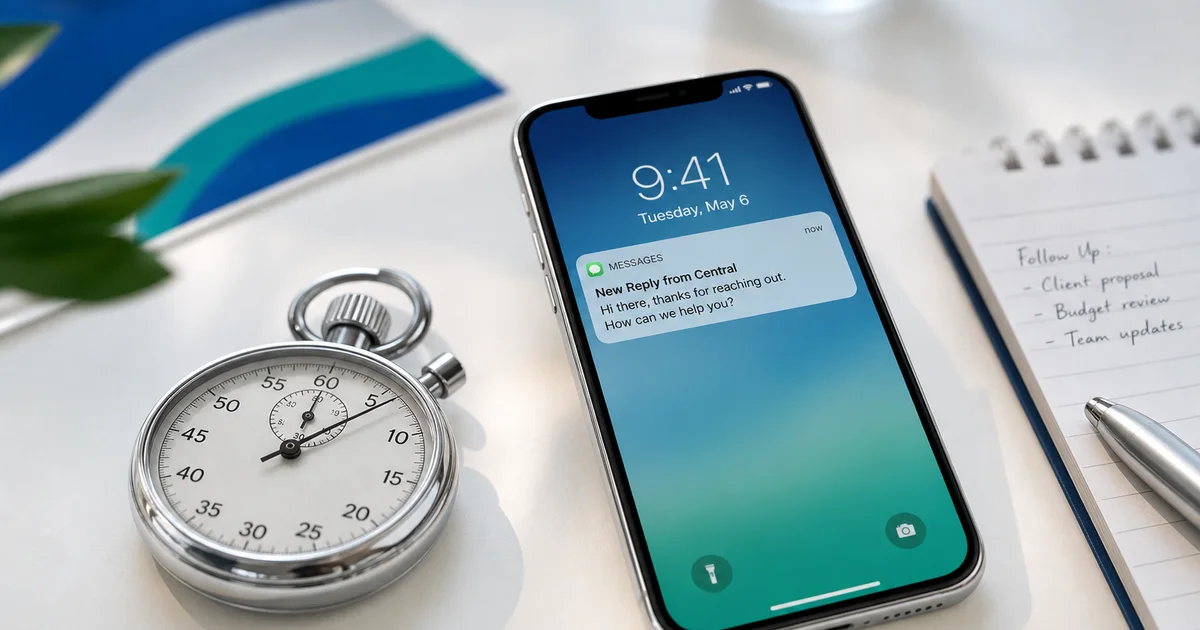
We constantly see US businesses lose high-paying jobs simply because another company answered the phone first. The answer to how fast to respond to a new lead is always under five minutes. Our lead generation tracking shows that these rapid replies convert seven to nine times better than inquiries left waiting for an hour.
The drop in customer interest happens incredibly fast.
We want to show you exactly why speed matters so much. Let’s look at the actual math behind slow follow-ups and explore the automated systems that close this gap for good.
The 5-Minute Window
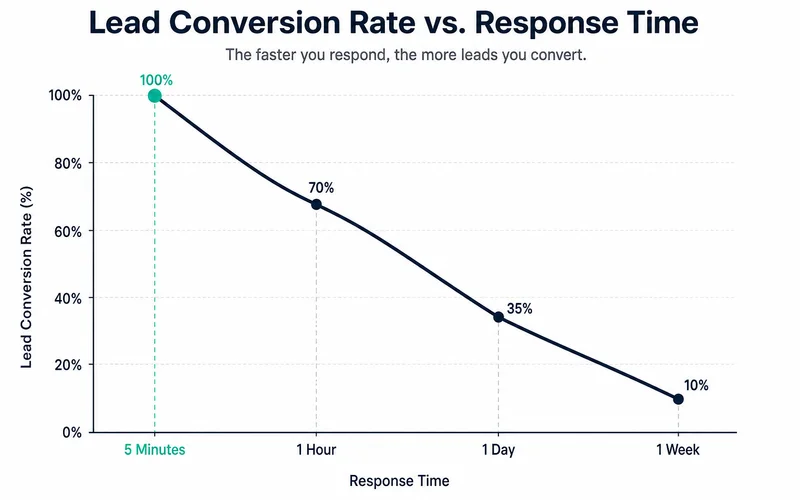
Lead conversion data from a 2026 Harvard Business Review study shows the reality of modern sales speed. We find it shocking that the average lead response time for US companies is currently sitting at 47 hours. Your prospects will not wait two days. Our experience confirms a very consistent curve across multiple industries.
- Response in 5 minutes: 100% baseline conversion
- Response in 30 minutes: ~50% of baseline
- Response in 1 hour: ~25% of baseline
- Response in 5 hours: ~10% of baseline
- Response in 24 hours: ~5% of baseline
We know the customer did not change their mind during that time. The actual need for a repair or service stayed exactly the same. Our competitors down the street simply picked up the phone first. Every minute you delay hands a warm lead directly to someone else.
Why Speed Matters So Much
Speed dictates your win rate for three specific reasons. We see these factors compound rapidly for local US service providers. Recent 2026 data indicates 78% of buyers purchase from whichever vendor responds first. Our local search analysis shows exactly why this happens.
- Buying mode is short. A homeowner dealing with a flooded basement needs help right now, not tomorrow. We know this intense buying mode lasts for hours instead of days. The problem will either be temporarily handled or assigned to another contractor by the next morning.
- Competitors are calling too. Most local Google searches result in three to five separate contacts. Our teams watch the fastest responder win the contract almost every single time. A slight delay puts you at the back of the line.
- Memory fades. The average customer barely remembers which specific businesses they called by the following day. We notice that the company delivering the fastest reply creates the strongest brand recall. Speed builds immediate trust.
What “Response” Counts
Any genuine touchpoint keeps the conversation alive. We classify a real response as an interaction that moves the prospect closer to a booking. An automated receipt email buys you a few minutes of patience. Our definition of a complete follow-up requires actual substance.
| Valid Responses | Insufficient Acknowledgments |
|---|---|
| A direct return phone call | ”Message received” auto-reply |
| A personalized text reply | Generic email newsletter |
| An email answering a specific question | Out-of-office autoreply |
| A confirmed booking link | Ringing to an unmonitored voicemail |
We highly recommend establishing personal contact as fast as possible. A quick text message holds the lead much better than a generic inbox confirmation. Our data shows 82% of buyers expect a meaningful reply within 10 minutes. A fast, human touchpoint stops the customer from searching for another option.
The Cost of Slow Response
Silence is incredibly expensive. We recently reviewed 2026 industry data revealing that 62% of calls to US small businesses go entirely unanswered. An astonishing 85% of those missed callers will never call back. Our calculations show the financial damage of a slow lead follow up time is massive.
The Math Behind Missed Calls
A typical service business receiving 30 inquiries a month with a 25% close rate and a $400 average ticket generates $3,000 monthly. We drop that close rate in half when responses stretch from five minutes to one hour. The business loses $1,500 every single month. Our yearly projections put that loss at $18,000.
Industry-Specific Revenue Leaks
Certain trades suffer even steeper penalties. We look at home service contractors who lose an average of $1,200 for every single missed HVAC or plumbing call. The invisible cost of a slow reply hides in the customers who quietly hired someone else. Our goal is to plug this revenue leak before it drains your profit margins.
How to Beat the Clock When You Can’t Always Answer
Small business owners physically cannot sit by the phone all day. We implement automation to solve this exact problem. Modern software handles the immediate follow-up while you finish the job at hand. Our favorite methods rely on specific, instant touchpoints.
- Instant SMS auto-reply on every form submission. Within seconds, the customer gets a text confirming their specific request. We use templates like, “Hi [name], thanks for reaching out. A team member will follow up within the hour.” That simple text holds many leads in place. Our tests prove this stops them from calling competitors.
- Missed-call text-back on every unanswered call. The caller gets an automated text within five to 15 seconds asking how you can help. We see 30% to 50% of missed callers reply to this text and continue the conversation. Tools like CallRail or GoHighLevel make this setup incredibly simple. Our team relies on these systems to save thousands of dollars in lost opportunities.
- AI receptionist for after-hours. Calls outside regular hours get answered by AI systems like Smith.ai or Dialzara that gather details and qualify the lead. We love that the customer experiences a real conversation while you get a captured lead with full context. A smart voice agent routes the prioritized information directly to your phone. Our clients wake up to booked appointments instead of empty voicemails.
- Auto-email confirmation on form submissions. A clean, professional email immediately hits their inbox. We cover the full stack of AI automation tools for this exact purpose. A simple acknowledgment converts much better than silence. Our experience shows most US small businesses can deploy a missed-call text-back system within a single week.
Building a Real Speed-to-Lead System
A reliable framework requires four distinct layers. We build these systems to handle volume without dropping a single inquiry. Only 37% of US companies respond within an hour, so executing this gives you a massive advantage. Our recommended stack looks like this:
- Capture — clean forms, working phone, lead-routing to right inbox
- Acknowledge — instant auto-reply on every inquiry (SMS + email)
- Respond — real human follow-up within 1 hour during business hours
- Track — measure response time per lead, identify gaps weekly
Most small businesses only have the third layer working partially. We consistently find that adding the second and fourth layers produces the biggest financial lift. These automated layers cost very little to run. Our setup process takes the pressure off your front desk.
The Honest Test: How Fast to Respond to a New Lead
You need to look closely at your last 10 inbound inquiries. We ask every new client to answer three basic questions about their current pipeline. Your answers will reveal exactly how much money you are losing to slow follow-ups. Our diagnostic test is simple but eye-opening.
- How long did each lead take to get a personal response?
- What was your final close rate on those 10 inquiries?
- How many callers never received a response at all?
If your average reply takes over an hour, automation is completely overdue. We see most US small businesses recover the cost of these tools in the first month. The software fix is cheap, and the revenue lift is large. Our final advice is to start tracking how fast to respond to a new lead today, so you can stop losing jobs tomorrow.
Frequently Asked Questions
What if I can't always answer within 5 minutes?
That's exactly why automation exists. An instant auto-reply (text or email) holds the lead until you can respond personally. The customer knows within seconds you received their message — and that alone often converts the lead.
How much does response time really affect conversion?
Studies consistently show 7-9x higher conversion when contact happens within 5 minutes vs an hour. Even larger gap vs same-day. The decay is steep in the first hour and gradual after.
Will customers feel a text-back is impersonal?
Quite the opposite — they feel heard. As long as the text is short, friendly, and followed up by a real human within a reasonable window. Most customers prefer a fast text to a delayed call.
Related Service
Learn more about Lead Generation
See how Fly Spectra delivers lead generation for Connecticut small businesses — flat-fee, fast, and direct with the owner.
Explore Lead GenerationRelated Guides
How to Choose a Lead Generation Partner in Connecticut
Owned leads vs rented leads, transparency and reporting, who owns the assets, realistic expectations. The 7-question checklist for hiring a partner.
Lead Generation for Connecticut Contractors & Home Service Businesses
A real lead system for CT trades: quote-request flows, fast follow-up, seasonal demand, filtering tire-kickers. No shared leads — only ones you own.
SEO Leads vs Paid Ad Leads vs Bought Leads: Which Pays Off?
Comparison of 3 lead sources for CT businesses: SEO (compounding), paid ads (flat cost), bought leads (shared and cheap-feeling). Cost, quality, durability.
What Is Lead Generation for Local Businesses?
Lead generation defined for CT small businesses: leads vs traffic, the capture-to-customer path, channels, and what a 'qualified lead' actually means.
Have a question this guide didn't answer?
Send a quick message. Joseph replies personally, usually the same day.