
How to Choose a Lead Generation Partner in Connecticut
Owned leads vs rented leads, transparency and reporting, who owns the assets, realistic expectations. The 7-question checklist for hiring a partner.

We know how frustrating it feels to hire a lead generation agency and see zero return on your investment.
The gap between a transparent growth partner and a company that simply rents you data is massive. Our team relies on a very specific evaluation checklist when making this choice.
Here is the exact framework we use ourselves when local business owners ask how to choose a lead generation company. Let’s look at the critical questions you need to ask and the warning signs to avoid.
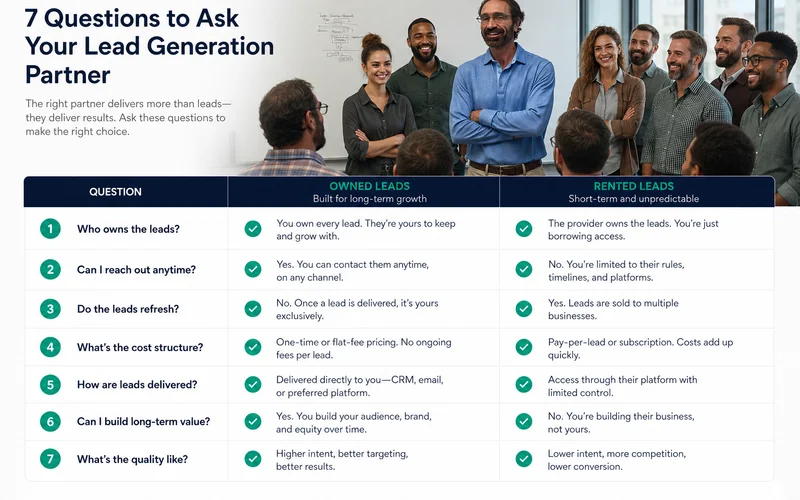
The 7 Questions to Ask
1. Are these owned leads or shared/rented leads?
This is the single most important question you can ask a prospective agency. Shared leads mean a platform sells the exact same contact information to three or five of your local competitors. You immediately enter a race to the bottom on price.
Our experience shows that owned assets build long-term equity for your Connecticut business. If a partner refuses to build owned channels, they are just reselling you access to their own machinery.
2. Who owns the assets?
You must maintain total administrative control over your website, content, and ad accounts. Agencies will sometimes build your site on a closed platform or set up a HubSpot or GoHighLevel CRM where you only have standard user access.
We always require clients to hold the “Super Admin” keys. That lock-in gives the agency artificial power if you ever decide to leave. Holding your domain hostage is an outdated but highly common tactic.
3. What is the contract length?
Month-to-month agreements are the modern standard for local service marketing. If a partner demands a six-month or twelve-month commitment upfront, they are buying time rather than earning your trust.
Our team operates on a 30-day cancellation policy because it forces us to deliver value immediately. Agencies like SalesHive and other top-tier firms have popularized the month-to-month structure to reduce client risk. Walk away from any long-term trap that lacks a performance-based exit clause.
4. What is included in monthly reporting?
Vanity metrics like impressions and clicks do not pay your payroll. A legitimate report details total volume, cost per customer, and the specific close rate of the campaigns.
We always track the Cost Per Qualified Lead (CPQL) because raw lead volume is useless if the contacts never buy. A 2026 HubSpot industry report found the average B2B cost per lead sits around $213. Your partner needs to benchmark your CPQL against your average customer lifetime value.
5. How do you measure success?
A vague promise to “keep working on it” is not a measurable business outcome. Success requires specific targets for qualified-lead rates and customer acquisition costs.
Our standard metric for a healthy campaign is keeping the cost of acquisition below ten percent of the customer’s total lifetime value. Recent data from Demand Gen Report shows that marketing-to-sales qualification rates recently dropped below ten percent across the industry. You need a partner who measures success by revenue, not just phone calls.
6. What does month 1 look like specifically?
Vague answers about “getting started” usually mean a slow, disorganized rollout. Month one must include a concrete list of deliverables like technical SEO audits, Google Tag Manager setup, and call tracking installation via tools like CallRail.
Our onboarding process outlines every exact software integration required before a single dollar goes to advertising. You should expect a highly specific calendar of foundation work.
7. What happens if I want to leave after 3 months?
Leaving an agency should never trigger hidden exit fees or penalty clauses. You should walk away with your complete customer list, Google Business Profile access, and all written content intact.
We structure offboarding so clients simply revoke our access and keep all their digital property. Beware of proprietary website builders that prevent you from exporting your site to a standard WordPress hosting environment.
Red Flags to Walk Away From
Finding the right fit means identifying bad actors before you sign anything. Certain sales tactics immediately signal a low-quality operation.
Our checklist highlights the most common warning signs.
- “Guaranteed leads” promises. Agencies promising fifty guaranteed leads a month are often just scraping outdated contact lists from tools like Apollo. Quality intent cannot be guaranteed before a campaign launches.
- Long-term lock-ins. Any ongoing service requiring more than a 30-day notice is a massive risk.
- Refusal to share access. A transparent partner gives you read-only or admin access to your Google Analytics and ad accounts.
- Vague pricing structures. Real professionals quote a specific scope of work and a clear price in writing.
- Missing local references. You need to speak with actual business owners in Hartford, Stamford, or your specific region.
- High-pressure sales. Tactics like “decide today to keep this rate” indicate desperation, not expertise.
Reporting Standards
Receiving a spreadsheet full of raw data is not the same as receiving a strategic report. You need clear answers that connect marketing activity directly to your bank account.
Our ideal monthly update covers seven vital performance indicators.
| Key Metric | What It Actually Tells You |
|---|---|
| Total Lead Volume | How many inquiries came in across all tracked channels. |
| Source Distribution | Which specific channels (organic SEO, paid ads, referrals) generated the most activity. |
| Qualification Rate | The percentage of total inquiries that were actual, viable prospects. |
| Close Rate & Value | How many qualified prospects signed a contract, and the average revenue per deal. |
| Cost Per Lead (CPL) | The total marketing spend divided by the number of acquired leads. |
| Completed Work | The specific tasks, content pieces, or technical fixes shipped this month. |
| Next Month’s Plan | The strategic focus and expected deliverables for the upcoming 30 days. |
If your current dashboard only highlights website traffic and social media likes, you are receiving a vanity report.
What “Done Well” Looks Like
A healthy marketing relationship follows a predictable timeline of growth. Building a system that outpaces your local Connecticut competitors requires a phased approach.
Our typical project roadmap sets clear expectations for the first year.
- Months 1-3 (Foundation): The agency sets up conversion tracking, fixes technical website errors, and establishes CRM automation. Lead volume stays close to your baseline.
- Months 3-6 (Traction): Traffic begins to convert at a higher rate. The cost per lead stabilizes, and the percentage of qualified prospects noticeably increases.
- Months 6-12 (Growth): Search engine optimization efforts start compounding. Lead volume scales to double or triple the initial baseline, while the overall acquisition cost drops.
- Year 2+ (Maturity): The business enjoys a stable, predictable flow of inquiries from multiple diversified sources.
Realistic Pricing
Bargain-basement marketing packages rarely produce meaningful results. You generally get exactly what you pay for when hiring a specialized team.
Our pricing guide reflects the actual costs required to run campaigns in 2026.
| Service Tier | Monthly Investment | What You Should Actually Get |
|---|---|---|
| Foundation | $500 - $1,000 | Website conversion fixes, basic local SEO targeting, lead capture forms, and honest monthly reporting. |
| Growth | $1,000 - $2,000 | The foundation package plus consistent content creation, paid ad management, and basic CRM tool integrations. |
| Scale | $2,000 - $5,000 | The growth package plus aggressive multi-channel advertising, advanced automation, and a dedicated strategy director. |
Anything priced below the $500 mark is almost always a templated, automated service with zero custom strategy.
How to Compare Two Proposals
Putting two agency proposals side-by-side often feels like comparing apples to oranges. You need a standardized way to evaluate the actual business value being offered.
Our final evaluation checklist strips away the marketing jargon.
- Specificity of deliverables: A good proposal lists exact tasks, while a bad one relies on vague promises.
- Asset ownership: You must retain total ownership of your website, domain, and data.
- Lead exclusivity: Ensure the agency is building your owned channels rather than renting you shared contacts.
- Contract flexibility: Prioritize agencies offering month-to-month agreements over long-term commitments.
- Metric quality: Look for a focus on Cost Per Qualified Lead (CPQL) rather than simple click-through rates.
- Reference strength: Demand to speak with current clients operating similar local service businesses.
- Communication clarity: The right partner explains their strategy in plain English.
A competent agency will make the answers to these points completely obvious during a thirty-minute discovery call.
Finding the best lead generation company CT has to offer means protecting your business by demanding clarity upfront.
When you are ready to hire a lead generation partner, use this framework to separate the actual experts from the imposters.
Frequently Asked Questions
Who owns the leads if I hire a lead generation company?
You should — always. If the answer is 'we do' or 'we share them with others,' walk away. Your leads, your customer relationships, your asset. Anything else is renting from someone who can stop renting any time.
Should I be locked into a 12-month contract?
No. Month-to-month is the modern standard. Long contracts protect the agency, not you. If a partner can't earn the next month every month, you shouldn't be obligated to pay for it.
How do I know if a lead generation partner is actually delivering?
Monthly reporting on leads, qualified leads, conversions, and cost per customer. Vanity metrics (clicks, impressions) alone don't count. The bottom line is paying customers, not website traffic.
Related Service
Learn more about Lead Generation
See how Fly Spectra delivers lead generation for Connecticut small businesses — flat-fee, fast, and direct with the owner.
Explore Lead GenerationRelated Guides
How Fast Should You Respond to a New Lead?
The 5-minute response rule explained: why leads go cold fast, what missed-call text-back recovers, and how to build a system that beats human reaction.
Lead Generation for Connecticut Contractors & Home Service Businesses
A real lead system for CT trades: quote-request flows, fast follow-up, seasonal demand, filtering tire-kickers. No shared leads — only ones you own.
SEO Leads vs Paid Ad Leads vs Bought Leads: Which Pays Off?
Comparison of 3 lead sources for CT businesses: SEO (compounding), paid ads (flat cost), bought leads (shared and cheap-feeling). Cost, quality, durability.
What Is Lead Generation for Local Businesses?
Lead generation defined for CT small businesses: leads vs traffic, the capture-to-customer path, channels, and what a 'qualified lead' actually means.
Have a question this guide didn't answer?
Send a quick message. Joseph replies personally, usually the same day.