
Why Online Reviews Matter for Local Search Rankings
Reviews are one of the top 3 local ranking signals. What review volume, recency, and keywords do for your CT business — and how to grow them safely.
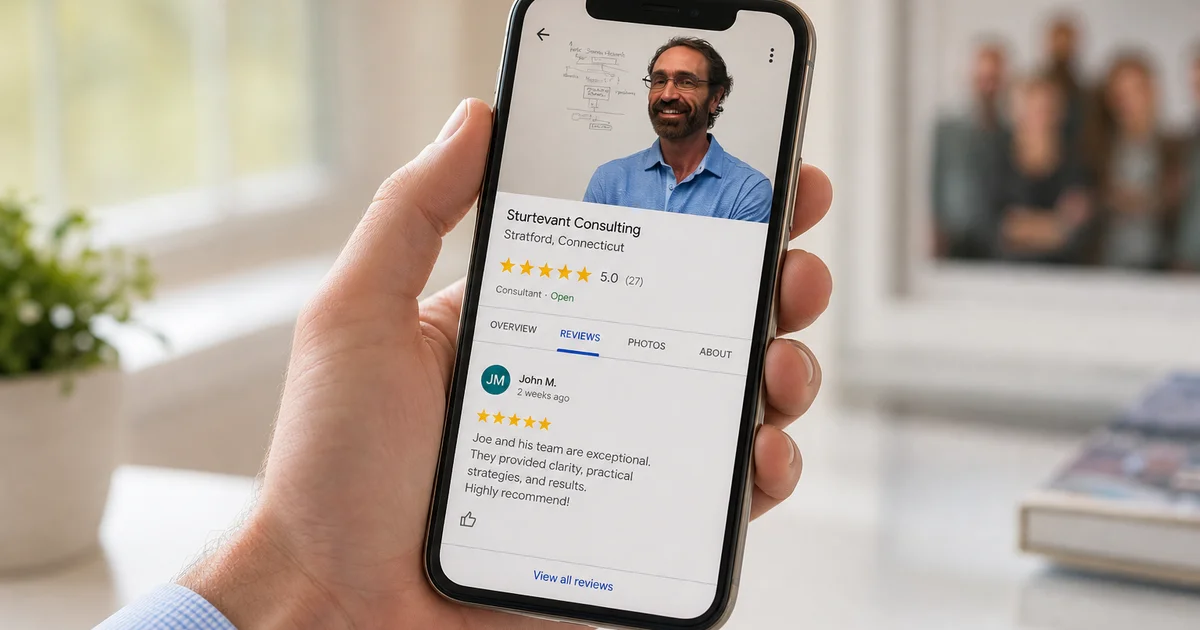
Our team consistently sees business owners ask: do reviews help local seo?
The short answer is an absolute yes. They are one of the top 3 ranking signals for local search, alongside Google Business Profile completeness and on-page relevance.
We often find that most local businesses underinvest in reviews and overinvest in everything else. This guide explains exactly how reviews affect your rankings and how to grow them without breaking strict new guidelines.
The Three Things Google Measures About Reviews: Do Reviews Help Local SEO?
We know it takes more than just a five-star average to dominate the Map Pack. Google evaluates several core metrics to calculate your profile’s internal quality score.
This directly answers the question of how do reviews help local seo today. Our recent 2026 local search data shows that 81% of US consumers use Google reviews to evaluate local businesses.
- Volume: Total reviews on your profile matter. Top-ranking Map Pack businesses typically have two to five times more reviews than those in position four or lower.
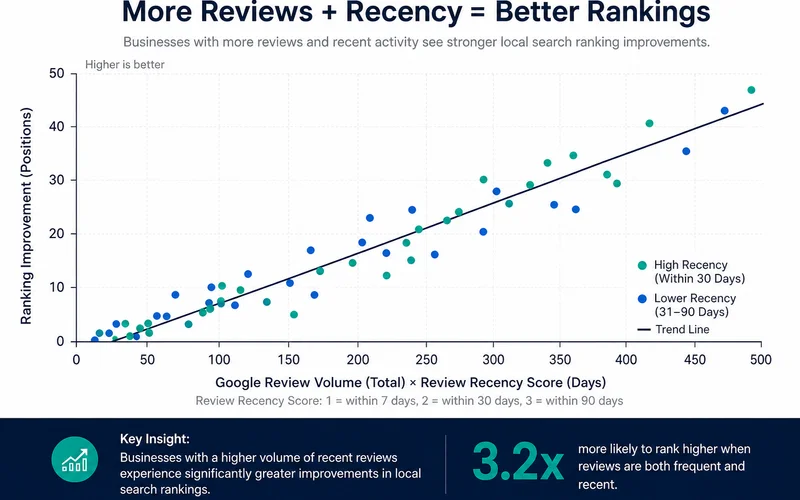
- Recency: When was your last review? Fresh signals dominate the algorithm. A profile with 50 reviews from 2024 and nothing recent ranks worse than one with 25 reviews where the most recent is three weeks ago.
- Frequency: Are you getting reviews steadily or in unnatural bursts? Steady weekly or monthly review volume looks much healthier than 30 reviews dropped in a single week.
We have found that star rating matters less than people think. A 4.7 average with 80 reviews will almost always outrank a perfect 5.0 with only 12 reviews.
Why Recency Matters So Much
Our data reveals that 73% of US consumers only trust reviews written in the last 30 days. Google’s algorithm assumes a business is currently active and well-run if it is accumulating fresh feedback.
A profile missing new reviews for six months looks dormant. This happens even if your business is thriving.
We recommend a structural fix to solve this issue. Get a review request workflow that runs every single week.
How Review Keywords Help SEO
We always look for natural service mentions in customer feedback. When customers mention specific services, those keywords feed directly into your long-tail search rankings.
Phrases like “they did our basement waterproofing” or “great kitchen remodel” carry immense weight. You cannot ask customers to use specific phrases or mention specific employees.
Our team advises letting the natural keywords flow from a real business transaction. Google now uses advanced Gemini AI models to analyze the semantic relevance of these keywords.
Why Response Rate Matters
We prioritize review responses because Google rewards highly active profiles. It serves as a massive trust signal that the business is customer-focused.
Your goal should be a response coverage rate above 90 percent. Every single review needs a thoughtful reply within a few days.
Industry data shows that 53% of US consumers expect a business to reply to negative reviews within a week, but we aim for a strict 48-hour response window.
For negative reviews, the response is much more important than the review itself. A measured and professional response to a 2-star review demonstrates that you handle problems well.
How to Grow Reviews Safely
Our compliant playbook focuses on consistency and speed. You must build a repeatable system that runs automatically to ensure a steady flow of feedback without triggering Google’s spam filters.
Proven Steps for Consistent Growth
- Ask every customer. Use the same process regardless of whether you think they will be positive.
- Ask within 48 hours. Memory fades fast. Customers who got service today are three times more likely to leave a review than customers from last week.
- Make it one-tap. Provide a direct link to your Google review form. Customers will abandon multi-step processes.
- Use SMS over email. Text messages dominate local service follow-ups.
- Follow up gently once. Send a second nudge five to seven days later and then stop.
We strongly suggest comparing your outreach methods to find what works best. SMS gets massive engagement for local service businesses across the US.
| Metric | SMS Text Messaging | Email Outreach |
|---|---|---|
| Average Open Rate | 98% | 20% - 25% |
| Response Time | 82% read within 5 minutes | Varies greatly |
| Conversion Rate (Local) | 29% - 45% | 1.5% - 5% |
What Not to Do
Our compliance team closely monitors shifting regulations to keep businesses safe. The rules around online feedback changed drastically over the last two years, so you must avoid these specific traps at all costs.
- Don’t buy reviews. They violate platform policies and US federal law. The FTC’s Consumer Review Rule now carries civil penalties of up to $53,088 per violation.
- Don’t gate. Asking happy customers to review on Google and unhappy customers to email you privately is explicitly prohibited.
- Don’t write your own. Do not ask your team or family either. Google’s 2026 AI detection tools catch this easily.
- Don’t incentivize. Offering discounts for reviews violates policy on both Google and most other platforms.
- Don’t ask for employee name drops. As of April 2026, Google penalizes businesses that instruct customers to name specific staff members.
Beyond Google: Where Else Matters
We know Google is the dominant Map Pack signal, but other platforms feed critical indirect signals. Apple Business Connect is now essential because iOS holds over 50% of the US mobile market.
Apple Maps pulls review data directly from Yelp and TripAdvisor. You should build your Google presence first before expanding to these directories.
Key Secondary Platforms
- Yelp matters heavily in categories like restaurants and professional services.
- Facebook reviews hold weight for businesses with a highly active social presence.
- Industry-specific sites build deep niche authority. Focus on Avvo for legal, Healthgrades for medical, or Houzz for home design.
Practical Starting Point
Our experience shows that most local businesses can easily earn 10 to 20 new reviews in their first 60 days. You just need to run a structured review request workflow.
That volume is enough to move Map Pack visibility for moderately competitive terms. The top three Map Pack results capture 44% of all local search clicks.
You can capture that traffic and convince visitors that you operate a real, active, and trusted business. Taking action today will ensure do reviews help local seo becomes a proven reality for your own bottom line.
Frequently Asked Questions
How many reviews do I need to rank in the Map Pack?
It's relative to competitors, not an absolute number. Aim to be in the top 30% of review count in your category for your service area. For most CT small businesses, 30-100 reviews puts you in striking distance of the Map Pack.
Do I need 5-star reviews, or are 4-star OK?
Both. A perfect 5.0 with 200 reviews can look fake to customers; 4.7-4.9 with steady recency reads as more authentic. Mix of mostly 5-star with occasional 4-star is the healthiest profile.
Can I gate reviews (ask happy customers privately first)?
No — Google's policy prohibits review gating and can suspend your profile. Ask everyone the same way; respond well to every result. Real review profiles include the occasional 3 or 4-star — and they look more trustworthy for it.
Related Service
Learn more about Local SEO
See how Fly Spectra delivers local seo for Connecticut small businesses — flat-fee, fast, and direct with the owner.
Explore Local SEORelated Guides
How Long Does Local SEO Take to Show Results?
Realistic local SEO timelines: 4-8 weeks for Map Pack movement, 3-6 months for stronger organic gains. What moves first and what to expect.
How to Choose a Local SEO Company in Connecticut
Avoid SEO scams and pick a real local partner. The 8 questions to ask, reporting red flags, and what realistic results look like for CT small businesses.
Local SEO for Connecticut Contractors & Home Service Businesses
Local SEO built for CT trades: service-area business setup, ranking across multiple towns, contractor-specific categories, citations, and review strategy.
Local SEO vs Google Ads for Connecticut Businesses: Where to Spend?
How CT businesses should split budget between local SEO and Google Ads. Cost-per-lead, speed, durability — and the blended approach that wins long-term.
Have a question this guide didn't answer?
Send a quick message. Joseph replies personally, usually the same day.