
Local SEO vs Google Ads for Connecticut Businesses
How CT businesses should split budget between local SEO and Google Ads. Cost-per-lead, speed, durability — and the blended approach that wins long-term.
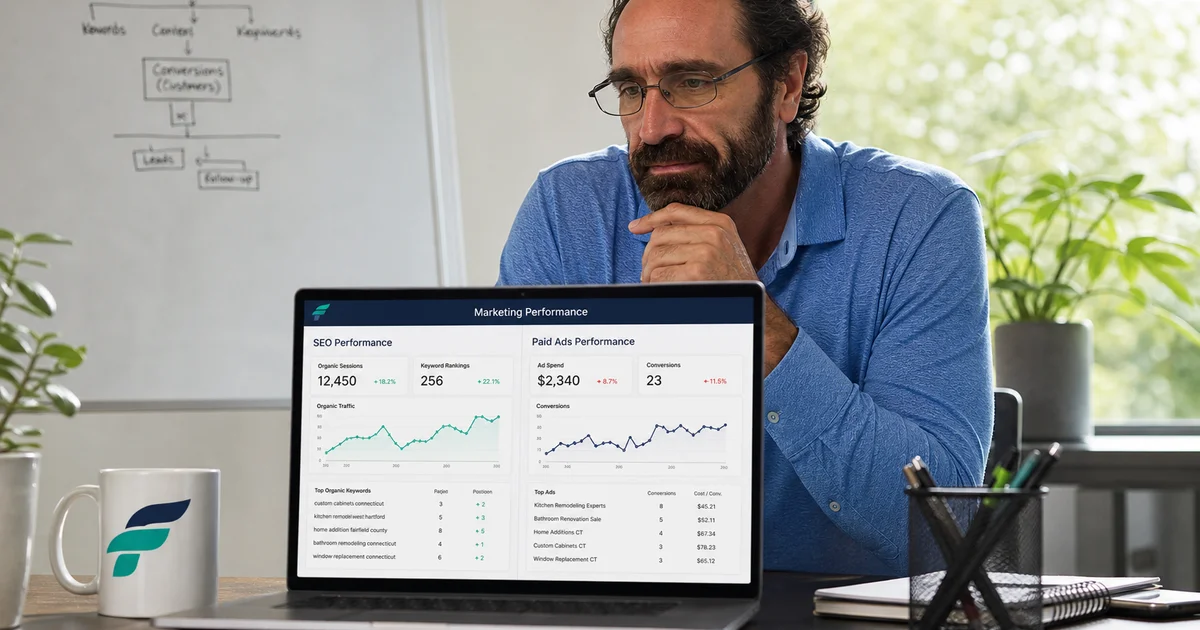
Most Hartford area business owners ask us the exact same question during budget planning season.
You have limited marketing dollars, and you need to know the winner in the local seo vs google ads debate. The data clearly shows that organic results secure about 70% of all search clicks, but paid campaigns put you at the top of the page within hours. Neither channel is a silver bullet on its own.
We are going to examine the true costs of each channel in 2026, review the latest cost-per-lead data for Connecticut, and lay out a strategic framework for allocating your budget.
The Headline Comparison: Local SEO vs Google Ads
Every solid marketing plan starts by looking at the core differences between these two powerful channels. Each approach solves a completely different business problem. A recent 2026 analysis from ClickVision revealed that organic traffic converts at an impressive 14.6% average rate. Paid traffic conversion rates sit lower at roughly 10%.
| Factor | Local SEO | Google Ads |
|---|---|---|
| Speed of results | 3-6 months | Days |
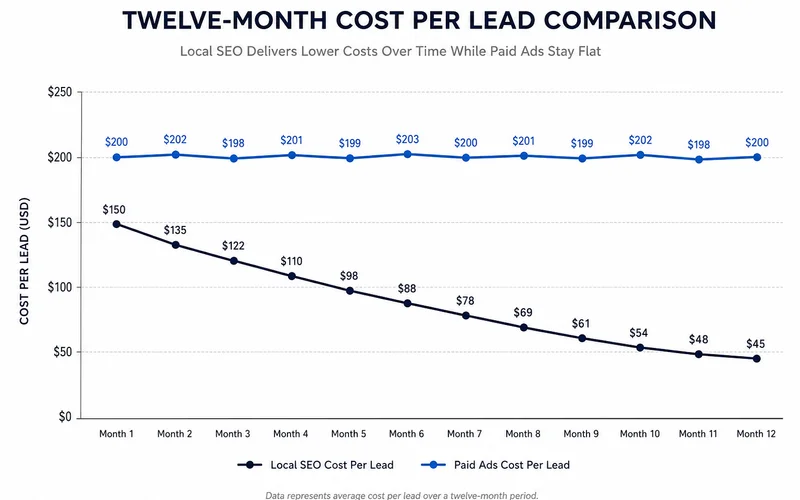
| Cost-per-lead over time | Drops | Flat or rises |
| Durability | Compounds; lasts after spend stops | Stops the day you stop paying |
| Predictability | Variable in early months | Predictable from week 1 |
| Best for | Long-term lead generation | Immediate demand, new businesses, testing |
These baseline differences shape every decision you make about your pipeline.
When Local SEO Wins
For most established Hartford County small businesses, local SEO is the better long-term investment. This channel requires patience, but it builds an asset you actually own.
Our team sees the greatest return on investment here because of the compounding mathematics. Every dollar you spend on optimization today continues to produce phone calls 12 months from now.
- Compounding cost. Your organic presence does not disappear when a budget pauses. The rankings and Google Business Profile optimizations you build generate passive traffic.
- Cost-per-lead drops. A first-year organic campaign might cost $80 per lead, but that cost drops significantly over time. Data from Howling Media in 2026 shows organic leads often drop below $30 by year two.
- You own the asset. Your citations, review profiles, and website content belong entirely to your brand.
- Better click share. Consumers overwhelmingly trust organic results. Recent 2026 industry benchmarks show that roughly 70% of searchers skip the sponsored section entirely.
The downside is the initial waiting period. The organic search process takes three to six months to produce a noticeable surge in lead volume. A business that needs cash flow by Friday cannot wait that long.
When Google Ads Win
We recommend paid search campaigns when you need to force immediate visibility. Google Ads bypasses the organic waiting game completely. You pay for top placement, and the phone starts ringing.
Our recent campaign data shows that Smart Bidding features now handle roughly 78% of ad spend in 2026. This artificial intelligence optimization reduces costs for mature accounts, but the platform remains expensive.
- You need leads this week. A contractor facing a slow schedule can activate a campaign and book jobs by tomorrow.
- Brand-new businesses. You can buy traffic while your organic foundation grows quietly in the background.
- Testing a new service. A 60-day paid test will quickly tell you if a new service offering has local market demand.
- Highly competitive categories. Some saturated markets take over a year to rank organically.
- Seasonal spikes. An HVAC company in Connecticut needs instant top-page placement during a July heatwave.
When evaluating ads vs seo for small business, paid campaigns function perfectly as a strategic lever. They buy you essential time and cash flow. They just should not be your only foundation.
The Blended Approach Most CT Businesses Should Run
We rarely advise clients to choose just one path. The most profitable Hartford County businesses skip the basic seo vs ppc argument and run both channels in a calculated sequence.
Months 1-3: The Immediate Push
You need immediate cash flow to fund long-term growth. We suggest running light paid campaigns at $500 to $1,500 per month. This captures high-intent buyers while you build your foundational website architecture and Google Business Profile.
Months 4-6: The Pivot
Your organic foundation will start producing meaningful traffic around this time. You can begin reducing your paid spend modestly. Reallocate those paid dollars to test new service angles or specific zip codes.
Months 6-12: The Dominant Channel
Organic search should become your primary source of inbound calls by the end of the year. You then reserve paid campaigns strictly for promotional pushes or emergency service keywords. A 2026 Codivox study demonstrated this exact phased approach. A local home service company dropped their effective cost per lead to just $73 by blending channels strategically over 12 months.
What Google Ads Actually Cost in CT
Our analysts review local search budgets constantly, and click costs continue to rise. A comprehensive 2026 benchmark report from WordStream revealed that the average cross-industry cost per click jumped 12% year over year to $2.96.
Connecticut service businesses pay significantly more than that national average.
- Service industries (plumbing, HVAC, roofing): $8 to $25 per click.
- Home improvement (remodeling, contractors): $10 to $30 per click in competitive Hartford zones, with national averages hitting $8.33.
- Professional services (legal, accounting): $15 to $50 per click.
- Retail and restaurants: $1 to $5 per click.
A click is not a lead. These paid visitors convert into phone calls at typical rates of 5% to 15%.
If you pay a $20 cost-per-click and convert 10% of those visitors, your actual cost-per-lead is $200. Most local categories need a minimum budget of $1,000 per month just to generate enough data for the algorithm to learn effectively.
What “Cheap” Lead Sources Get You
We often speak with contractors who try to bypass search engines entirely by purchasing leads from third-party marketplaces. Services like HomeAdvisor, Angi, and Thumbtack sell leads for $20 to $40 each. The math looks incredibly appealing on paper.
The reality of these shared lead platforms is much darker.
- Extreme competition. The platform sells that exact same lead to three to eight of your local competitors simultaneously.
- Price matching wars. You end up in a race to the bottom on price just to win the job.
- Dismal conversion rates. Recent 2026 data from Blue Grid Media shows the average close rate on Angi leads is a painful 12%.
- No long-term equity. You do not own the customer relationship or the initial point of contact.
When you account for the low close rate, the true cost per booked job on a shared platform often exceeds $500. Leads generated through your own organic presence are exclusively yours and typically convert at three to five times the rate of a shared marketplace lead.
How to Decide for Your Business
We use a very simple framework to help owners decide between local seo or google ads. You can follow this quick decision tree to find your starting point.
- Cash flow tight, need leads this month? Start with ads. Add an organic growth strategy as soon as you can afford parallel work.
- Stable cash flow, can wait 3-6 months for compounding? Start with organic optimization. Add ads selectively for new launches or seasonal pushes.
- Highly competitive category with long organic timelines? Run both in parallel from day one.
- Trying to validate a new service? Use ads to test for 60 days. If the market responds well, double down with an organic content strategy.
For most established Hartford County small businesses, settling the local seo vs google ads debate means choosing an organic-first approach with paid support. The compounding economics of a strong organic foundation win over a 12-month horizon for almost every category. Start reviewing your current cost per acquisition today, and adjust your budget allocation to prioritize the assets you actually own.
Frequently Asked Questions
If I only have budget for one, which should I pick?
For most established CT small businesses: local SEO first, ads later. For brand-new businesses needing leads immediately: ads first, SEO compounding behind. The right answer depends on whether you can wait 3-6 months or need leads tomorrow.
How much should I spend on Google Ads in CT?
Most small businesses need $500-$2,000/month to test honestly. Less than $500 usually doesn't produce statistically useful data. Most local categories in Hartford County run $5-$25 per click depending on competitiveness.
Do you run Google Ads?
Not as a core service. We focus on local SEO and lead automation, and refer to trusted Hartford County PPC specialists when paid ads are the right fit. Mixing both well usually requires two specialists, not one generalist.
Related Service
Learn more about Local SEO
See how Fly Spectra delivers local seo for Connecticut small businesses — flat-fee, fast, and direct with the owner.
Explore Local SEORelated Guides
How Long Does Local SEO Take to Show Results?
Realistic local SEO timelines: 4-8 weeks for Map Pack movement, 3-6 months for stronger organic gains. What moves first and what to expect.
How to Choose a Local SEO Company in Connecticut
Avoid SEO scams and pick a real local partner. The 8 questions to ask, reporting red flags, and what realistic results look like for CT small businesses.
Local SEO for Connecticut Contractors & Home Service Businesses
Local SEO built for CT trades: service-area business setup, ranking across multiple towns, contractor-specific categories, citations, and review strategy.
What Is Local SEO and How Does It Work?
Local SEO defined in plain English: Map Pack vs organic, GBP, citations, reviews, and the 3 signals Google uses to rank local businesses.
Have a question this guide didn't answer?
Send a quick message. Joseph replies personally, usually the same day.