
Local SEO for Connecticut Contractors & Home Service Businesses
Local SEO built for CT trades: service-area business setup, ranking across multiple towns, contractor-specific categories, citations, and review strategy.

We know that running a Hartford County home-service business requires a completely different playbook than marketing a traditional storefront. Most standard advice simply falls flat for businesses without walk-in traffic.
Our team sees this shift happening across the US every day. The rules for local seo for contractors have tightened significantly this year. Google treats service-area profiles with much more scrutiny, requiring your website to do the heavy lifting to prove local relevance.
Here is a look at what actually drives rankings for CT trades right now.
This guide covers the exact priority order for maximizing your visibility and booking more jobs.
Service-Area Business (SAB) vs Storefront
If customers come directly to your physical address, you operate a storefront. If you drive a truck to your customers, Google categorizes you strictly as a service-area business (SAB).
Our onboarding process always starts with this distinction because getting it wrong can trigger an immediate profile suspension. For an SAB, Google requires you to hide your home address and list your service areas instead. The platform strictly limits you to a maximum of 20 specific towns or zip codes.
Many contractors still have their home address showing publicly, which causes massive confusion in local search. A quick check is essential right now. If you do not receive walk-in customers at your physical address, you must change this setting immediately.
| Feature | Storefront | Service-Area Business (SAB) |
|---|---|---|
| Address Display | Visible on Google Maps | Hidden from public view |
| Proximity Core | Centered on physical building | Centered on hidden verified address |
| Location Limits | Single physical site | Up to 20 defined service areas |
Why Multi-Town Ranking Works Differently
Your Google Business Profile ranks strongest in the exact city where your address is verified. For any nearby towns, your visibility drops rapidly due to Google’s strict proximity signals.
We are seeing a major shift in 2026 regarding this exact ranking factor. Search engine data from this year shows that Google has tightened the “near me” radius significantly for trades. This means an HVAC technician might only rank within a small 2-mile zone around their hidden address without extra optimization.
Because Map Pack visibility decays with distance, you must build heavy prominence signals to expand that reach. The most effective fix for multi-town coverage is building dedicated service-area landing pages directly on your website.
Core Requirements for Multi-Town Reach
- Strong GBP Optimization: Maximum authority in your verified address city.
- Dedicated Landing Pages: 5 to 10 service-area pages for surrounding towns.
- Hyper-Local Content: Real details about local neighborhoods and common job types.
- Geographic Schema: Code that links your page to specific local coordinates.
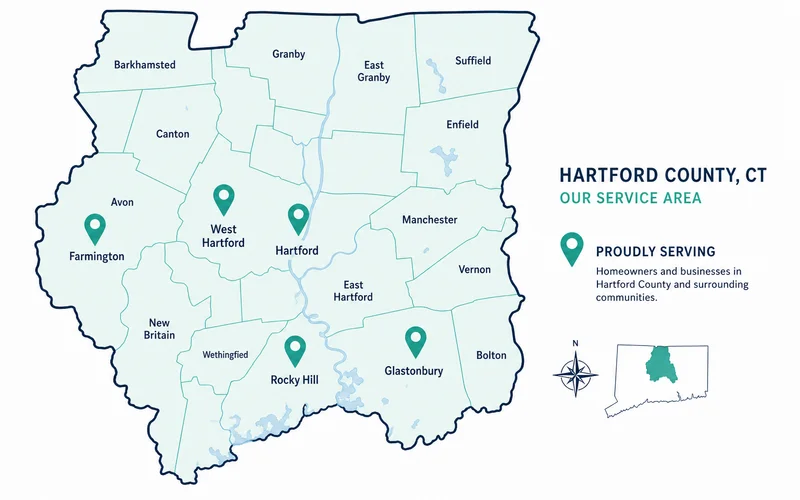
These dedicated pages capture organic search traffic even when your GBP cannot physically reach into those surrounding towns. To compete effectively, a typical CT contractor needs this specific baseline setup.
Contractor-Specific GBP Categories
Selecting the wrong primary category is the single biggest ranking killer for a home service seo connecticut strategy. You must choose a highly specific category, as generic tags like “Contractor” will rank you for almost nothing.
Our audits consistently show that precise categories like “HVAC contractor” or “Roofing contractor” signal exact relevance to Google. There are currently over 4,000 active Google Business Profile categories as of 2026. This means you have a massive opportunity to define your exact niche.
Your primary category must perfectly match your highest-value search intent. Recent 2026 algorithm studies confirm that category selection drives up to 32% of your total local ranking power.
Strategic Category Selection
| Element | Recommended Action | Common Mistake to Avoid |
|---|---|---|
| Primary Category | Select the exact specific trade (e.g., Plumber). | Choosing a vague term like “General Contractor”. |
| Secondary Categories | Add 5 to 9 highly relevant related services. | Adding dozens of unrelated services to chase traffic. |
| Competitor Analysis | Match the primary categories of top-ranking peers. | Guessing based on what sounds professional. |
Citation Strategy for Trades
For trades, a strong citation strategy requires building consistent business listings across high-authority, industry-specific directories. The goal is perfectly matching your Name, Address, and Phone number (NAP) everywhere online.
We see that inconsistent NAP data actively suppresses rankings in 2026. Google cross-references these specific directories to verify your legitimacy. You need to focus on quality over quantity to build genuine trust signals.
You must skip the cheap “1,000 citations for $99” services completely. Most of these bulk providers generate low-quality spam links that can trigger algorithmic penalties.
Essential Core Directories (Free)
- Google Business Profile
- Bing Places
- Apple Maps
- Facebook Business Page
- Yelp
Industry Standard Platforms
- BBB (Better Business Bureau)
- Nextdoor
- HomeAdvisor (free profile, separate from paid leads)
- Angi (free profile, separate from paid leads)
Trade-Specific Directories
- Houzz (interior designers, landscapers)
- Porch (general contractors)
- Thumbtack (mobile services)
- Local industry association directories
Review Strategy for Trades
A winning review strategy for trades relies on asking for feedback immediately on-site while the customer is still highly satisfied. Trades possess a structural advantage because every single completed job is a fresh opportunity to earn a review.
Our data shows that timing and delivery method dictate your success rate entirely. The most effective patterns for earning consistent five-star ratings are clear and measurable in 2026.
Proven Review Generation Tactics
- Ask at the end of the job, on-site. This guarantees the highest initial response rate from homeowners.
- Send the request by text within 24 hours. 2026 industry benchmarks show SMS requests convert at roughly 45%, while email hovers around a dismal 6%.
- Make it one tap. Always provide a direct link straight to the Google review form.
- Encourage photo reviews. Customer photos add massive credibility and automatically feed your GBP photo gallery.
- Respond to every review within a few days. A public, professional response on negatives shows future customers how you handle disputes.
A well-run CT contractor should easily accumulate 5 to 15 new reviews per month based on standard job volume. Earning a 4.5-star average or higher dramatically increases your lead conversion rate compared to lower-rated competitors.
Seasonal Demand and Content Cadence
You must publish seasonal content six to eight weeks before peak demand hits to ensure Google has time to index and rank your pages. Connecticut trade demand spikes in highly predictable seasonal patterns.
We always build content calendars around these specific regional shifts. Google’s 2026 search algorithm heavily favors fresh, highly relevant local information. If you wait until a summer heatwave to post about AC repair, you have already lost the search traffic to competitors.
Connecticut Seasonal Timelines
- HVAC: Peak demand hits in late spring for AC and early fall for heating.
- Landscaping: Strong consistent demand runs from early spring through early fall.
- Roofing: The busiest booking periods occur in late spring and early fall.
- Snow Management: Contracts close from late fall through the winter months.
For effective contractor local seo ct, the smartest play is anticipation. Pre-summer AC content published in March will consistently beat reactive content uploaded in July.
On-Page Schema for Trades
Adding specific structured data markup to your website is the most effective way to help search engines instantly understand your local services. On-page schema acts as a direct translator between your website code and Google’s ranking algorithm.
Our developers prioritize this step because most agency-built contractor sites skip schema entirely. In 2026, over 40% of local queries trigger AI Overviews, and these modern systems rely heavily on structured data to pull accurate entity information.
Essential Schema Types for Contractors
- LocalBusiness: Use this core tag for the overarching business entity.
- HomeAndConstructionBusiness: Deploy this as a broad parent type for general trades.
- Trade-Specific Subtypes: Implement exact tags like Plumber, Electrician, HVACBusiness, or RoofingContractor.
- FAQPage: Apply this to frequently asked questions sections for rich-result eligibility.
- Service: Place this markup on individual service landing pages detailing your offerings.
Taking the time to implement correct schema is one of the highest-leverage seo for trades improvements available today.
Local SEO for Contractors: What a 6-Month Program Looks Like
A standard six-month campaign moves systematically from technical foundation repair to aggressive local content expansion. When looking at a typical CT contractor local SEO engagement, you can expect a very structured, predictable timeline for growth.
We track these specific milestones to ensure every technical fix translates into actual phone calls. Recent 2026 consumer data shows that 88% of local mobile searches result in a call or booking within 24 hours. You need a fast, authoritative presence built to capture that exact high-intent traffic.
The Six-Month Roadmap
- Month 1 (Foundation): We execute a deep GBP audit, clean up NAP inconsistencies, deploy on-page schema, and finalize your service-area page strategy.
- Month 2-3 (Build): The focus shifts to launching service-area landing pages for primary towns, uploading job photos, and installing an automated review workflow.
- Month 4-6 (Compound): Routine monthly posts, fresh seasonal content, and steady review accumulation begin moving your Map Pack rankings significantly.
By the end of month six, most home service businesses see a measurable lift in high-quality inbound calls and form submissions. Once you cross the 12-month mark, your organic presence compounds so heavily that your cost-per-lead drops well below standard paid advertising costs.
If your trade business suffers from weak Map Pack visibility or fails to rank in neighboring towns, that gap in your local seo for contractors is almost always fixable. We gladly perform free 20-minute audits upon request to outline your exact next steps.
Frequently Asked Questions
Can I rank in multiple towns from one GBP?
Your GBP ranks best in your physical address city, but well-built service-area pages on your website can rank organically in surrounding towns. Most CT contractors should target their address city in Map Pack and surrounding towns in organic.
Should I list every town I serve on Google?
Add the service-area towns you actually cover (up to ~20). Don't pad it — Google ignores or penalizes obvious area stuffing. Quality over quantity. Be specific about where you work, not aspirational.
Are paid directories (BBB, Angi) worth it for contractors?
Free citations are essential — top 30 directories matter. Paid directories are optional and depend on your trade. BBB is widely trusted; Angi varies. We'll tell you which ones return for your specific category.
Related Service
Learn more about Local SEO
See how Fly Spectra delivers local seo for Connecticut small businesses — flat-fee, fast, and direct with the owner.
Explore Local SEORelated Guides
How Long Does Local SEO Take to Show Results?
Realistic local SEO timelines: 4-8 weeks for Map Pack movement, 3-6 months for stronger organic gains. What moves first and what to expect.
How to Choose a Local SEO Company in Connecticut
Avoid SEO scams and pick a real local partner. The 8 questions to ask, reporting red flags, and what realistic results look like for CT small businesses.
Local SEO vs Google Ads for Connecticut Businesses: Where to Spend?
How CT businesses should split budget between local SEO and Google Ads. Cost-per-lead, speed, durability — and the blended approach that wins long-term.
What Is Local SEO and How Does It Work?
Local SEO defined in plain English: Map Pack vs organic, GBP, citations, reviews, and the 3 signals Google uses to rank local businesses.
Have a question this guide didn't answer?
Send a quick message. Joseph replies personally, usually the same day.