
What Makes a Good Small Business Website?
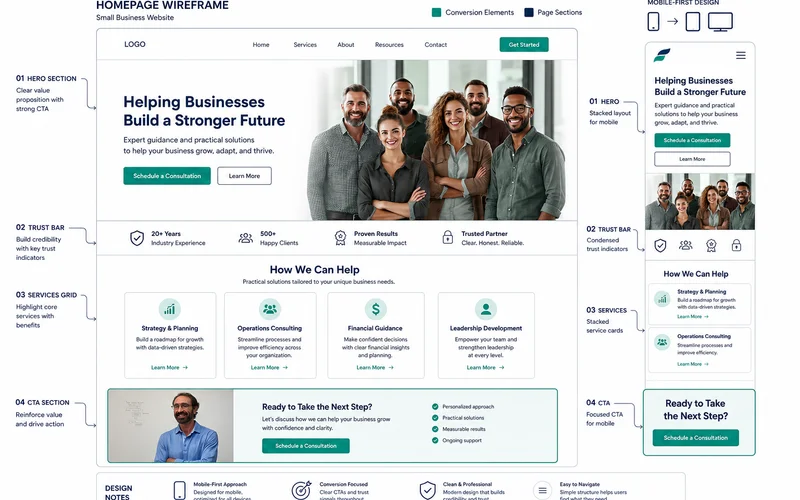
The 7 things every small business website needs: clear messaging, mobile-first design, fast load, trust signals, lead capture, local SEO, and easy editing.

A highly effective website functions as a 24-hour sales representative, which is why understanding what makes a good small business website is essential.
Our team often sees business owners treating their sites like passive digital brochures. That exact misunderstanding is why so many US companies miss out on high-quality local leads. We have spent over eight years building websites for Hartford County small businesses, carefully tracking what actually drives phone calls.
A 2024 SCORE survey found that 27% of small businesses still lack a website, giving you an immediate opportunity to stand out. Our goal here is to share the core fundamentals that separate a high-performing site from a wasted investment. Let us look at the data and break down the exact design elements you need to implement today.
The 7 Essentials
Every successful digital storefront shares a few small business website essentials. Our audits consistently show that missing even two of these elements causes a sharp drop in customer inquiries.
1. A Clear Value Proposition Above the Fold
The headline on your homepage is the single most critical piece of copy you will ever write. We recommend using a direct, one-sentence subhead instead of a vague corporate mission statement.
According to 2026 US market research, 75% of consumers judge a company’s credibility based entirely on website design and initial messaging. Our clients see the best results when visitors understand the service offering within five seconds.
This immediate clarity prevents users from bouncing back to the search results. We structure the top of the page to answer three specific questions immediately:
- What specific service do you offer?
- Which exact geographic area do you serve?
- What makes you the best choice for the job?
Answering these questions replaces abstract cloud photography with a strong, conversion-focused primary call to action.
2. Mobile-First Responsive Layout
Google now uses the mobile version of your pages to decide where you rank online. Our development process prioritizes phone screens first, because over 67% of all web traffic in 2026 comes from mobile users.
This mobile-first indexing rule means desktop-only designs actively harm your local search visibility. We ensure every layout features tap-friendly buttons, easily accessible contact information, and forms that work without zooming.
A 2026 performance analysis shows that desktop conversion rates average 3.99%, while mobile drops to 1.22% for unoptimized sites. Our team focuses on closing that gap by removing friction for phone users.
| Device Focus | 2026 Search Impact | User Experience Requirement |
|---|---|---|
| Mobile | Primary Google Index | Thumb-friendly buttons, fast rendering |
| Desktop | Secondary Index | Wide layouts, detailed hover states |
You must provide a highly optimized mobile experience to compete effectively in local markets.
3. Fast Load Speed (Under 2.5 Seconds LCP)
Website speed acts as a direct multiplier for your conversion rate. We target a Largest Contentful Paint (LCP) of under 2.5 seconds on a 4G connection.
Google reports that reducing page load time from three seconds to one second can boost conversion rates by up to 27 percent. Our technical SEO audits focus heavily on Interaction to Next Paint (INP), a 2026 metric where the goal is a response time under 200 milliseconds.
Slow pages frustrate visitors before the homepage even renders. Here are the three Core Web Vitals we measure:
- Largest Contentful Paint (LCP) for loading speed.
- Interaction to Next Paint (INP) for responsiveness.
- Cumulative Layout Shift (CLS) for visual stability.
We optimize these specific vitals to protect your rankings and keep potential customers engaged. A visually stable page prevents users from accidentally clicking the wrong link as elements shift during loading.
4. Real Trust Signals
Specific, verifiable credentials build immediate confidence with hesitant buyers. Our consumer tracking shows that 81% of US shoppers conduct online research before ever contacting a business.
A BrightLocal study confirms that 76% of people check a website before visiting a physical store. We place authentic trust signals high on the page so visitors see them without scrolling.
Generic stock photos and vague claims of being highly rated carry zero weight today. Our designs incorporate specific elements to establish instant authority:
- Real, verified customer reviews with names.
- Authentic photographs of the team and location.
- Visible industry certifications and licenses.
- A physical, verifiable business address.
These concrete details separate a legitimate local operation from a fly-by-night competitor.
5. Lead Capture on Every Page
An interested visitor needs an obvious, frictionless way to take the next step. We place a clear call to action every two or three sections on longer pages.
Recent 2026 data shows that 88% of users will not return to a site after a frustrating experience, like a broken or hidden form. Our layouts always include a click-to-call phone number and a straightforward contact form.
Adding a chat option can further reduce the barrier to entry for users who prefer not to call. We make it impossible for a potential client to leave without seeing exactly how to reach out. Here is what every business website needs for lead capture:
- Sticky header with a clickable phone number.
- Short-form fields (name, email, phone, message).
- Clear confirmation page after submission.
A simple form submission process prevents lost opportunities and drives consistent inquiries.
6. Local SEO Foundations
Proper technical architecture determines how easily local customers find your services. Our strategy builds local schema markup and geo-signals directly into the foundation from day one.
In 2026, proper LocalBusiness Schema markup can increase click-through rates by 20 to 30 percent in search results. We also prepare sites for Generative Engine Optimization by using structured data to feed Google’s AI Overviews.
The first 80% of local SEO impact comes from these foundational elements, not expensive ongoing monthly work. Our local optimization process ensures strict consistency for your Name, Address, and Phone number across the entire web.
| SEO Approach | Primary Tactics | 2026 Effectiveness |
|---|---|---|
| Traditional | Keyword stuffing, hidden text | Very Low (Penalized) |
| Modern Local | Schema markup, consistent NAP, fast LCP | High (AI-Ready) |
Trying to bolt these features onto a poorly built site later is inefficient and costly.
7. Easy Editing After Launch
A static website quickly becomes outdated and irrelevant. We use modern, lightweight tech stacks that make updating hours or adding photos incredibly straightforward.
Current performance data reveals that Next.js and similar modern frameworks pass Core Web Vitals 58% of the time, while heavy WordPress page builders struggle at 38%. Our clients appreciate the ability to tweak copy and swap images without calling a developer.
Bloated page builders make routine maintenance painful and slow down your load speeds. We train business owners to take control of their content quickly and easily, using manageable backend interfaces to handle several tasks:
- Update holiday hours instantly.
- Publish new completed project photos.
- Adjust pricing or service details.
These good website features save time and eliminate frustrating bottlenecks.
The Common Pattern Behind All Seven
Every essential feature discussed above shares a single goal. We focus entirely on reducing friction between a casual visitor and a paying customer.
A slow load time, buried contact information, and an unclear value proposition all create unnecessary friction. Our primary job is to remove those roadblocks at every possible step.
Quick self-check: Open your site on your phone, in a coffee shop’s WiFi. Time how long it takes to load, then try to call the business in one tap. If either step felt slow, your real visitors had the same experience.
The sites that convert best are the ones that respect the user’s time. We constantly test these friction points to ensure a smooth path to purchase.
What Makes a Good Small Business Website “Modern” in 2026
Modern web design focuses on performance and clarity over trendy animations. Our approach centers on a lightweight technical foundation and conversion paths that actually work on a mobile device.
Mobile-first indexing is universal in 2026, meaning Google evaluates the mobile version of your site before the desktop version. We prioritize structured data (Schema.org) so search engines clearly understand your local business category.
Most agency-built sites still skip this crucial schema markup step entirely. Our developers know that implementing structured data is one of the easiest, highest-leverage SEO wins available today. A fully modern setup requires three technical implementations:
- LocalBusiness Schema for accurate category mapping.
- Clean llms.txt files to feed AI crawlers.
- Mobile-first code structures for faster rendering.
Preparing your site with these elements ensures your business appears correctly in emerging discovery tools.
When to Rebuild vs Improve
Deciding whether to start over or fix an existing site is a common challenge. We find that if your current platform relies on a bloated page builder, lacks mobile responsiveness, or takes more than four seconds to load, a complete rebuild is usually cheaper.
Recent data shows that 47% of websites currently fail Core Web Vitals, and patching a poorly built architecture rarely produces a fast site. Our targeted improvement strategies work best when the foundation is solid but the messaging is weak.
Small tweaks like rewriting hero copy or adding lead capture forms can lift inquiries quickly on a healthy platform. We always ask clients a simple, honest question to determine the right path:
Would you be embarrassed to send this specific site to a prospective customer right now? If yes, that is your answer.
Understanding what makes a good small business website is the first step toward getting better results. Most of our custom Fly Spectra builds launch in about two weeks for a flat fee, proving that a high-converting digital storefront does not need to be expensive. We offer a quick conversation to show you exactly what an upgraded presence would look like for your company.
Frequently Asked Questions
What is the most important page on a small business website?
The homepage — it has the highest traffic share and must communicate what you do, who for, and how to contact you within 5 seconds. Make the first viewport carry the value proposition, a clear next step, and visible trust signals.
How many pages does a small business website need?
Most CT small businesses need 6-10 pages: home, about, contact, plus one page per main service. Add more only if you have multiple distinct service lines or locations. Quality of each page matters more than total count.
Do small business websites need a blog?
A blog helps if it is updated. For most small businesses, support guides and service pages do more SEO work than a sporadic blog. If you can't commit to fresh posts at least monthly, skip the blog and focus on evergreen guides instead.
Related Service
Learn more about Web Design
See how Fly Spectra delivers web design for Connecticut small businesses — flat-fee, fast, and direct with the owner.
Explore Web DesignRelated Guides
Custom Website vs Website Builders (Wix, Squarespace, GoDaddy)
Wix and Squarespace are fine for some businesses — and the wrong choice for others. Honest comparison: SEO, speed, customization, ownership, total cost.
How Long Does It Take to Build a Website? (Real Timelines)
Most small business websites can launch in about 2 weeks. See the real stage-by-stage timeline, what affects speed, and what clients need to provide.
How Much Does a Website Cost in Connecticut? (2026 Pricing Guide)
Real CT website pricing in 2026: starter $1.5K, standard $2.5-$4K, custom $5K+. Plus what drives cost, what's included, and how flat-fee saves you money.
How to Choose a Web Designer in Connecticut (Owner's Checklist)
An honest checklist for hiring a CT web designer: portfolio checks, contract red flags, what to ask about SEO, ownership, timelines, and post-launch support.
Have a question this guide didn't answer?
Send a quick message. Joseph replies personally, usually the same day.