
How Long Does It Take to Build a Website?
Most small business websites can launch in about 2 weeks. See the real stage-by-stage timeline, what affects speed, and what clients need to provide.
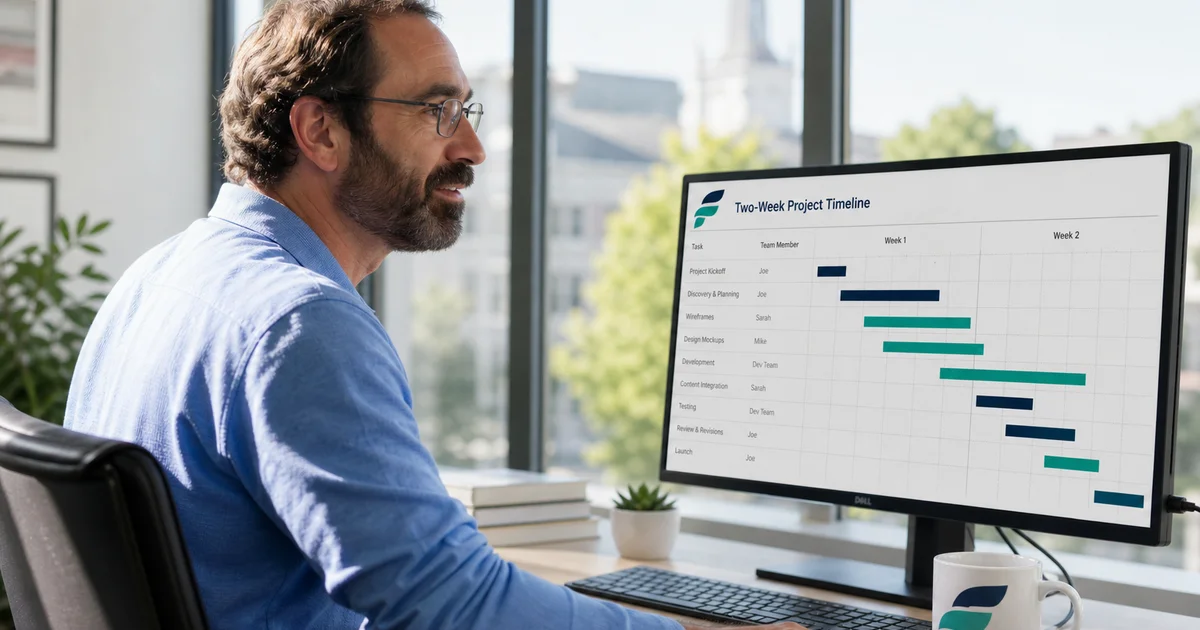
Most small business websites launch in about two weeks. This rapid two-week website timeline is the realistic goal for a standard 6-10 page site.
We run a tight schedule for all of our web design projects to prevent the delays that often drag out the national average to 8 to 16 weeks.
Hitting that target requires a focused system rather than an open-ended process. Let’s walk through the actual stage-by-stage breakdown to see what makes a project move faster or stall completely.
Week 1: Discovery, Design, Content
Our team uses the first five days to set the foundation for the entire build. A quick 30-minute discovery call confirms the scope and locks your pricing in writing. Getting everything organized on day one prevents frantic searches later.
Days 1-2: Project Discovery and Asset Collection
We require your logo, brand assets, and photos immediately following the kickoff. You simply drop the following items into a shared Google Drive folder:
- Copy outlines and basic text drafts.
- Our team also needs your Google Business Profile access.
- Current site analytics and historical data.
A centralized storage system keeps all files secure and easy to find.
Days 3-5: Wireframes and Visual Design
We then build a clean wireframe in a shared workspace like Figma to establish the layout. You get to see the progress every single day instead of waiting for a massive milestone reveal. One round of structured feedback at the end of the week keeps the momentum going.
Days 6-7: The Content Load
Our developers spend the weekend loading all your copy, images, and assets onto the staging site. Most clients provide raw content like basic services and pricing, which gets shaped into conversion-focused copy. Full content writing is always an available add-on if you want a complete rewrite.
Our approach sidesteps a major industry bottleneck regarding content creation. According to 2026 data from Reboot Online, manual content creation can delay a launch by 4 to 6 weeks. Having those raw materials ready makes all the difference in meeting the deadline.
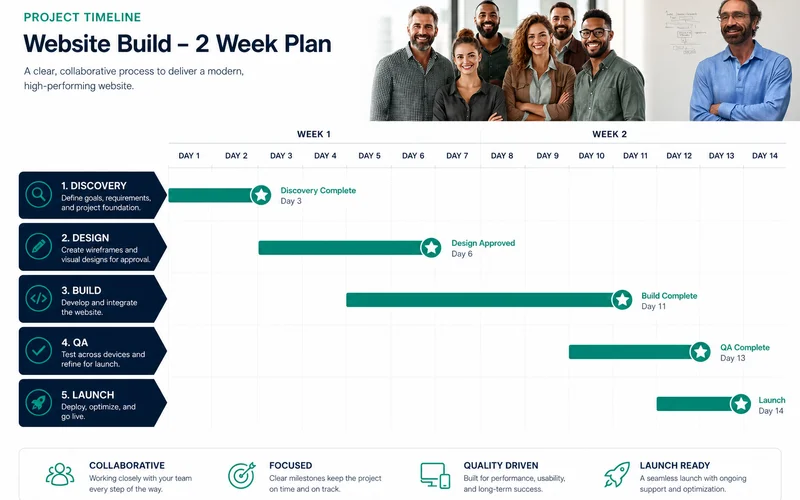
Week 2: Build, SEO, QA, Launch
Our developers transform the approved designs into a fully functional product during the second week. The technical setup begins immediately to ensure peak performance. Building the pages on a lightweight, modern tech stack guarantees a fast loading speed.
Days 8-10: Technical Build and Optimization
We wire in local schema markup and mobile-first responsive design straight away. Passing Google’s Core Web Vitals is mandatory for modern search rankings. The site must load its largest contentful paint in under 2.5 seconds to pass those checks.
Days 11-12: SEO Finalization and Quality Assurance
We finalize all on-page SEO elements, including title tags, meta descriptions, and internal linking structures. The quality assurance phase happens next, utilizing testing tools like BrowserStack. This phase includes checking the layout across the following environments:
- Our developers test on real iPhones and Android devices.
- Standard tablet displays.
- High-resolution desktop monitors.
Our standard protocol involves squashing bugs, polishing the layout, and running accessibility checks to wrap up the testing period.
Days 13-14: Migration and Launch
A standard DNS swap points your domain to the new hosting environment. A brief walkthrough video shows you exactly how to update the content yourself moving forward.
Our launch process includes setting up 301 redirects to preserve your existing search equity if you are migrating an older site. The final step involves pushing the site live to the public. The new website is now ready to generate leads.
What Slows Projects Down
We see three specific roadblocks that consistently stall momentum. The honest truth is that clients often slow down web design timelines more than agencies do. Across the US market, research shows that a massive percentage of technical projects experience significant delays.
Our process requires active participation to avoid a schedule drift of three to seven days. Disorganized content collection is a primary factor in missed digital deadlines. Here are the three most common causes of stalled progress:
- Late content delivery: Our timeline requires photos and copy on day three to prevent severe bottlenecks. Arriving in week two instead pushes everything completely sideways. Missing basic assets derails the entire layout process.
- Scope changes post-approval: Our project managers finalize the scope to avoid triggering a redesign cycle. Adding new pages or shifting layouts after signing off forces developers to backtrack. Scope creep burns through budgeted hours very quickly.
- Waiting on third parties: We strongly advise securing domain access from previous developers before the kickoff call. Photographers or brand consultants can freeze progress entirely if they miss their deadlines. Gathering those logins and assets beforehand is absolutely critical.
What Speeds Projects Up
Our most successful launches happen when clients come fully prepared. Preparation eliminates the friction that normally drags out a build. Following a few simple steps guarantees a faster turnaround.
We recommend organizing a simple Google Docs file containing your services, pricing, contact info, and a few bullet points per service. Having your logo and brand files ready in a single folder makes the designer’s job much easier. Providing Google Business Profile access on day one prevents launch day panic.
We also ask that you block out 30 minutes for two feedback rounds during the first week. Completing those specific tasks ensures the project finishes right on schedule. Skipping any of them will likely cause unnecessary frustration.
Our data shows a stark difference between prepared and unprepared project starts. This quick comparison highlights the impact of having your materials ready. The numbers speak for themselves when it comes to efficiency.
| Requirement | Prepared Client Timeline | Unprepared Client Timeline |
|---|---|---|
| Brand Assets & Logo | Ready on Day 1 | Delayed by 3-5 Days |
| Content Outlines | Simple Google Doc provided | Waiting 2 weeks for copy |
| GBP & Domain Access | Logins verified upfront | Locked out by old developer |
| Feedback Rounds | Completed in 24 hours | Stalled for a week |
When 3-4 Weeks Is Realistic
Our standard sprint expands to three or four weeks when certain add-ons are involved. Clients often ask exactly how long to design a website with highly custom features. A larger scope simply demands a longer production schedule.
We typically extend the project timeframe for the following complex elements:
- Sites with 15+ pages: Each distinct layout needs its own dedicated quality assurance pass.
- Ground-up content writing: Producing optimized text from stakeholder interviews is a massive task.
Our copywriters need at least an extra week to handle heavy content creation.
- Custom software integrations: Connecting tools like HubSpot, WooCommerce, or Mindbody requires thorough API testing.
- Full scope photoshoots: Professional photography adds scheduling, shooting, and editing time to the build.
Our developers must build separate, localized landing pages for multi-location businesses. Complex functional requirements simply cannot be rushed without sacrificing quality. Thorough testing ensures those advanced features actually work perfectly on launch day.
We always evaluate your specific needs and clearly quote the timeline alongside the price upfront. This transparency ensures you never face unexpected delays mid-project. Knowing the exact launch date helps you coordinate your broader marketing strategy.
How We Hit the Timeline
Our ability to hit these rapid deadlines comes down to two operational rules. First, the entire scope gets written out and approved before any quote is issued. This guarantees everyone knows exactly what is included before a single line of code is written.
We eliminate the internal handoffs that usually destroy context and cause mistakes. You work directly with the senior experts doing the actual building. There are no junior account managers relaying messages like a game of telephone.
Our direct communication model cuts days of wasted time out of the overall process. If your launch date is tied to a specific event or an end-of-quarter rebrand, mention it early. A known constraint allows for flexible scheduling to guarantee an on-time delivery.
Ready to Start Your Project?
Our team is ready to help you launch a high-performing site without the agonizing wait. A fast, professional turnaround is entirely possible when you have the right system in place.
Stop losing customers to outdated pages and slow load times.
We invite you to reach out today to schedule your kickoff call. Let’s get your business the online presence it deserves. Contact us now to lock in your project schedule.
Frequently Asked Questions
Can you build a website in a week?
A simple 3-5 page site, yes — when content and logo are ready on day one. Most small business sites comfortably launch in two weeks. Anything tighter than a week usually means cutting corners on QA or copy quality.
What slows down a website project?
Late content from the client, repeated scope changes after design approval, and waiting on photography are the three most common reasons. Lining up content and logo before kickoff is the single biggest speed lever you control.
Do I have to be available the whole 2 weeks?
No — you need about 2-3 short feedback windows. Most clients give 30 minutes twice during week 1 and a final review near launch. The work happens on our side; you weigh in at decision points.
Related Service
Learn more about Web Design
See how Fly Spectra delivers web design for Connecticut small businesses — flat-fee, fast, and direct with the owner.
Explore Web DesignRelated Guides
Custom Website vs Website Builders (Wix, Squarespace, GoDaddy)
Wix and Squarespace are fine for some businesses — and the wrong choice for others. Honest comparison: SEO, speed, customization, ownership, total cost.
How Much Does a Website Cost in Connecticut? (2026 Pricing Guide)
Real CT website pricing in 2026: starter $1.5K, standard $2.5-$4K, custom $5K+. Plus what drives cost, what's included, and how flat-fee saves you money.
How to Choose a Web Designer in Connecticut (Owner's Checklist)
An honest checklist for hiring a CT web designer: portfolio checks, contract red flags, what to ask about SEO, ownership, timelines, and post-launch support.
Web Design for Connecticut Contractors & Home Service Businesses
A modern contractor website that drives quotes, not just visits. Built for CT trades: clear services, mobile click-to-call, lead forms, and photo galleries.
Have a question this guide didn't answer?
Send a quick message. Joseph replies personally, usually the same day.