
How to Choose a Web Designer in Connecticut
An honest checklist for hiring a CT web designer: portfolio checks, contract red flags, what to ask about SEO, ownership, timelines, and post-launch support.

We see the consequences of rushed vendor choices playing out across local business sectors every single day. A poor hiring decision leaves managers paying a second agency to fix a broken site two years later. Learning how to choose a web designer requires a strategic approach to protect your operational budget.
This checklist is exactly the framework we use ourselves when business owners ask how to evaluate digital options.
Our team developed this specific vetting process to avoid those expensive, time-consuming mistakes. Let’s look at the data, what it actually tells us, and explore practical ways to respond to standard agency pitches.
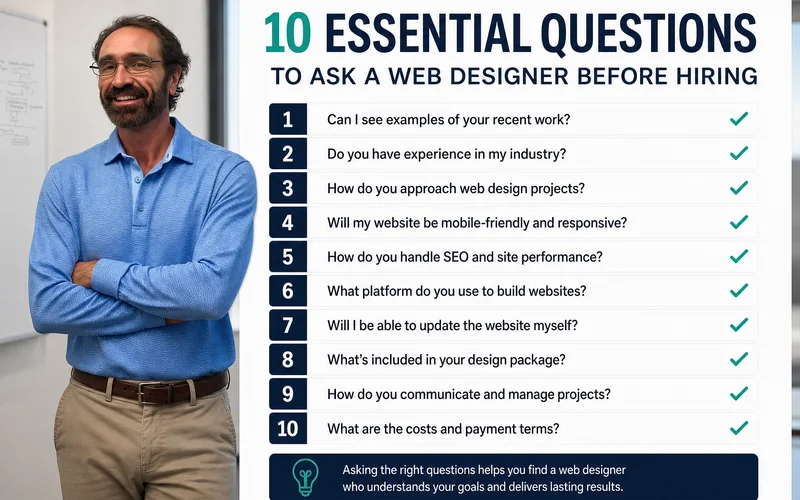
10 Questions to Ask Every Web Designer
Our screening process starts with direct, uncompromising inquiries. Finding the right partner means getting specific answers about their operational methods and policies. We categorize the most effective web designer questions to ask into three critical areas.
Ownership and Technical Stack
1. Who owns the website, domain, content, and source files after launch? Your answer must be a definitive “you do.” Anything else is a trap designed to hold your digital presence hostage.
2. What technology will my site be built on? The platform choice impacts everything from server speed to data security. Recent industry data shows WordPress currently powers 43.5% of all websites globally. Modern lightweight stacks like Astro or Next.js offer excellent performance alternatives. Vague answers signal disorganized, unpredictable work.
3. What is included in the price, and what is extra? Pin down hosting, monthly maintenance, technical SEO, content writing, integrations, and post-launch support specifically.
Project Timelines and SEO Approach
4. What is the timeline, and what causes delays? A real answer mentions client-side delays and content collection honestly. Vague timelines always result in vague delivery dates.
5. What is your SEO approach, specifically? A competent agency discusses schema markup, mobile-first indexing rules, and page speed optimization. Answering “we add some keywords” is not a legitimate SEO approach.
6. Do you guarantee Google rankings? The correct answer is an absolute no. Anyone who guarantees position number one is either lying or running a scam.
Support and Contract Terms
7. Show me 3 live sites you built in the last 12 months on my phone. Look at the actual sites in your browser instead of relying on cherry-picked screenshots. Testing load speed and the mobile user experience yourself is mandatory.
8. What happens if I want to make changes after launch? Editing simple text pages should be entirely straightforward. Beware of designers who require you to pay high hourly rates for every minor typo update.
9. What is the contract length? Flat-fee one-time payments are standard for basic website builds. Long contracts protect the agency instead of protecting your cash flow.
10. What is your post-launch support window? A 30-day minimum for build fixes is standard industry practice.
How to Read a Portfolio
We never evaluate a designer based solely on their own homepage. An agency will always polish their own branding while rushing smaller client deliverables. You must open three live client sites on your actual phone to see the unedited truth.
Our favorite testing method requires zero technical skills and takes less than five minutes.
- Load speed. Slow pages kill user conversions instantly. You can run their client sites through free diagnostic tools like Google PageSpeed Insights. If their other clients have slow load times, yours will definitely be slow too.
- Mobile experience. Tap targets on mobile devices must be at least 44x44 pixels for accurate clicking. Broken forms and unclickable phone numbers will absolutely show up on your site.
- Visual variety. Identical layouts across three different client sites reveal a lazy production process. You are getting a pre-made template instead of genuine custom work.
- Real content. Placeholder text and generic stock copy indicate poor quality control. A professional team ensures every single detail is finished before launching.
| Portfolio Element | Green Flag Indicator | Red Flag Warning |
|---|---|---|
| Performance | Scores above 85 on Google PageSpeed Insights | Pages take longer than 3 seconds to load |
| Mobile Design | Elements adapt perfectly to small smartphone screens | Text requires constant zooming to read |
| Structure | Custom layouts specific to the business model | Identical formatting across all client examples |
Contract Red Flags
Our legal reviews often uncover hidden financial traps in standard design agreements. Signing a bad contract creates massive liabilities for your business operations. We highly recommend walking away from any proposal containing these specific elements.
Federal guidelines established the WCAG 2.2 Level AA accessibility standard as a major legal requirement in 2026. A missing compliance clause leaves you completely vulnerable to ADA lawsuits.
- Long lock-in. Anything beyond a 30-day cancellation notice for ongoing services is highly excessive.
- Vague scope. Proposals must list specific functional deliverables and exact page counts.
- Asset ownership unclear. Your domain registrar account, hosting provider, written content, and source files must explicitly belong to you.
- No post-launch fix window. A reasonable designer fixes the technical bugs they shipped, entirely for free, for a 30-day minimum.
- No written quote. Verbal pricing remains unenforceable and always changes when disputes arise.
- Upfront payment in full. A standard financial split is 50% to start and 50% at launch. Some professional designers prefer three equal milestone payments.
What “SEO Included” Really Means
We see dozens of proposals claiming that search optimization comes standard. This phrase can mean anything from setting a basic title tag to building a complete technical foundation. You must demand specifics to protect your future search visibility.
A recent 2026 performance analysis found that 47% of all websites fail Google’s Core Web Vitals assessment. A true SEO package addresses these exact performance metrics head-on.
- Do you implement structured data (Schema.org) for LocalBusiness identification?
- Do you build separate, highly targeted landing pages for each main service and service area?
- Do you optimize for Core Web Vitals with a Largest Contentful Paint under 2.5 seconds on mobile devices?
- Do you pass the new Interaction to Next Paint metric by keeping responsiveness delays under 200 milliseconds?
- Do you migrate old URLs with 301 redirects to preserve existing search equity?
If any answer is “we can add that for extra,” the service was never actually included in the base price.
Realistic Pricing Expectations
Our local market pricing data shows that choosing a web designer ct companies rely on means expecting quotes between $1,500 and $5,000 flat-fee. This range provides enough budget for high-quality design without bloated agency fees. We cover the full financial picture in our guide on how much a website costs in Connecticut.
A price tag dramatically below $1,500 practically guarantees you are buying a recycled visual template. Quotes stretching dramatically above $5,000 usually indicate you are paying for an agency’s expensive office space.
| Provider Type | Typical Price Range | Best Fit For |
|---|---|---|
| DIY Platforms (Wix, Shopify) | $30 to $300 per month | Startups with zero budget and high free time |
| Freelance Designers | $1,500 to $5,000 | Most local small businesses in Connecticut |
| Large Creative Agencies | $10,000 to $30,000+ | National brands needing complex custom software |
The 2-Minute Phone Test
We recommend running a final behavioral check before signing any legally binding paperwork. Ask your top two candidates to schedule a brief 15-minute introductory phone call. You can easily judge their professional maturity based on three simple conversational interactions.
Our team evaluates these vendor calls strictly on communication style rather than technical jargon.
- Did they actively listen, or did they just pitch their services?
- Did they explain things in plain English, or in confusing industry acronyms?
- Did they ask intelligent questions about your business, or just talk about their own achievements?
The right professional designer for your business will pass all three criteria easily. Most unqualified vendors fail this communication test immediately.
To successfully hire web designer connecticut agencies respect, observing these small details makes a massive difference. Start your evaluation process today by scheduling those 15-minute introductory calls to narrow down your top choices.
Frequently Asked Questions
What's the single most important question to ask a web designer?
'Who owns the website, content, and domain after launch?' If the answer is anything other than 'you do,' walk away. Ownership of your own digital assets is non-negotiable.
Should I hire a freelancer or an agency?
Depends on scope and risk tolerance. Solo or small-team designers work direct-to-owner with lower cost; large agencies add layers, cost, and redundancy. For most CT small business sites, solo-to-small-team is the better fit.
Is it OK if the designer is not local?
It can work, but a local CT designer understands Hartford County customers, can meet in person, and knows the local SEO market. For sites where local rankings matter, local designers usually deliver better foundations.
Related Service
Learn more about Web Design
See how Fly Spectra delivers web design for Connecticut small businesses — flat-fee, fast, and direct with the owner.
Explore Web DesignRelated Guides
Custom Website vs Website Builders (Wix, Squarespace, GoDaddy)
Wix and Squarespace are fine for some businesses — and the wrong choice for others. Honest comparison: SEO, speed, customization, ownership, total cost.
How Long Does It Take to Build a Website? (Real Timelines)
Most small business websites can launch in about 2 weeks. See the real stage-by-stage timeline, what affects speed, and what clients need to provide.
How Much Does a Website Cost in Connecticut? (2026 Pricing Guide)
Real CT website pricing in 2026: starter $1.5K, standard $2.5-$4K, custom $5K+. Plus what drives cost, what's included, and how flat-fee saves you money.
Web Design for Connecticut Contractors & Home Service Businesses
A modern contractor website that drives quotes, not just visits. Built for CT trades: clear services, mobile click-to-call, lead forms, and photo galleries.
Have a question this guide didn't answer?
Send a quick message. Joseph replies personally, usually the same day.