
What Is Online Reputation Management?
Online reputation management defined for CT small businesses: reviews, ratings, search results, monitoring vs generation — and why it matters for rankings.
We see it happen constantly in the local market.
A single unhappy client leaves a bad rating, and the phone suddenly stops ringing. That sudden drop in leads is exactly why understanding what is online reputation management is critical for business survival.
Our daily local SEO work proves that actively managing your digital image is no longer optional.
Recent data from BrightLocal’s 2026 US survey shows that 31% of consumers now filter out any business with less than 4.5 stars. This means a mediocre rating immediately eliminates a third of your potential buyers before they even read a word about your services.
We will break down the exact strategies working right now to fix this problem. Let’s look at the core components of a healthy review profile. Then, you can implement our simple weekly routine to keep those star ratings high.
What ORM Actually Covers
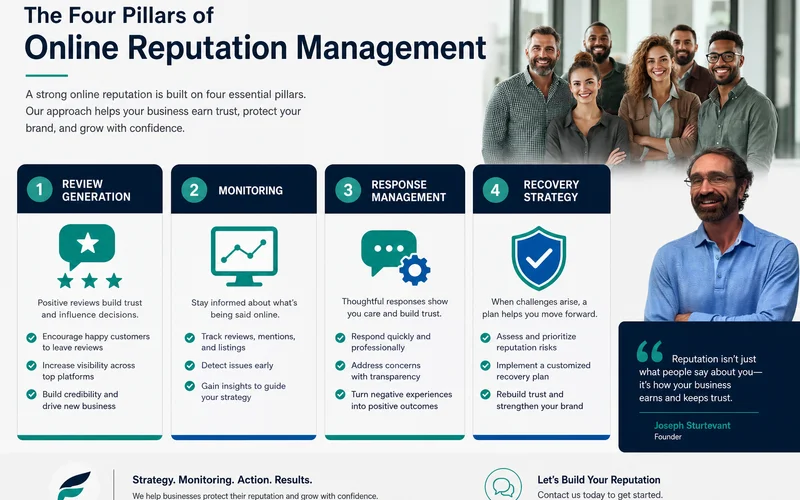
Online reputation management covers the continuous cycle of generating, monitoring, and responding to customer feedback across digital platforms. This proactive process directly shapes the first impression local buyers form when they search for your services. We view real reputation building as a five-step system that requires constant attention.
If you are wondering what is ORM on a daily basis, it includes these essential phases:
- Review generation: A structured workflow asks happy customers for feedback on the right platforms at the exact right time. Our analysis of BrightLocal’s 2026 US data shows that 74% of consumers only care about reviews written in the last three months.
- Review monitoring: We recommend tracking new feedback across Google, Facebook, Yelp, and niche directories weekly. Platforms like Houzz work well for design, while Avvo remains essential for legal professionals.
- Review response: Replying to both positive and negative comments within 48 hours shows future buyers that you run a responsive operation.
- Reputation recovery: We escalate policy violations directly through the Google Business Profile dispute process. Flagging specific guideline breaches is the only legitimate way to remove fake or hateful submissions.
- Search result management: Pushing down negative links takes months of consistent content publishing and technical optimization. Our approach focuses on influencing the top 5 to 10 search results that appear for your brand name.
Why ORM Matters More Than Most Owners Think
A strong review profile is a top-three ranking signal for the Google Map Pack and a massive driver of actual sales. Consistent feedback proves to algorithms that your business is active and trustworthy. We track these local search ranking factors closely every year.
The 2026 Whitespark US report confirms that Google Business Profile signals account for 32% of your local ranking power, while review signals make up another 20%. Volume, recency, and response rates all feed directly into this local algorithm. Our clients see massive traffic shifts when they start actively generating new feedback.
Good scores also drive direct conversions. We know that potential buyers study your profile before clicking the call button or visiting your store. A 4.8 average with detailed recent feedback converts dramatically better than a 4.6 with sparse old ratings.
This simple comparison shows why engagement matters:
| Feature | Active Business Profile | Dormant Business Profile |
|---|---|---|
| Review Age | Within the last 30 days | Over 6 months old |
| Response Rate | 95% of reviews answered | 0% of reviews answered |
| Map Pack Result | High visibility and traffic | Buried below competitors |
Generation vs Monitoring: Two Halves of ORM
Effective reputation building requires both proactive generation and defensive monitoring to create a complete system. Most standard services focus heavily on one side of the equation and completely miss half the picture. We see businesses fail when they treat these tasks as separate operations.
Mastering these online reputation management basics requires a balanced approach:
- Generation alone: You do lots of asking but lack a system for handling public complaints.
- Monitoring alone: You observe what is happening but fail to grow the asset.
- The Complete Approach: You ask for fresh feedback while actively managing the responses.
Our recommendation is to ask 10 to 30 happy customers per month for their honest thoughts. Sending these requests via text message is significantly more effective than traditional methods. We use recent 2026 US market data from TrueReview to guide this specific approach.
Their benchmarks show that SMS text requests generate a 25% to 40% click-through rate, while email requests hover around 5% to 12%. Texting converts to completed ratings at roughly three times the rate of email. Our daily operations combine this high-converting SMS outreach with weekly monitoring across all major platforms.
What ORM Cannot Do
Online reputation management cannot fix poor customer service or instantly delete legitimate negative feedback. You have to be honest about the strict limits of these digital tools. We always set clear expectations before starting any campaign:
- It cannot remove legitimate complaints. Only policy-violating remarks like fake, off-topic, or hateful content can be removed through official channels.
- It cannot guarantee flawless five-star ratings. Real profiles include occasional lower ratings, which actually makes your business look authentic to modern consumers.
- It cannot work around bad service. If your service quality is the core problem, shining a spotlight on it will only amplify the issue.
- It cannot bury negative search results overnight. Pushing unfavorable results down the search page takes months of dedicated content creation.
Our legal understanding of the US Federal Trade Commission Consumer Review Rule reinforces these strict boundaries. Heavily enforced through 2026, the FTC imposes civil penalties of up to $53,088 per violation for suppressing negative comments or incentivizing fake positive ones. Ethical compliance is now a major financial necessity.
We advise fixing operational service gaps internally before asking the public for their thoughts. Treating this process as a long-term investment in trust signals is the only sustainable path forward.
Where to Focus ORM Investment
Small businesses should focus their primary reputation investment on Google Business Profile before expanding to secondary platforms. You do not need active management on every single website to see results. We recommend picking the two or three directories that matter most for your specific category:
- Google: This is the most important focus area by far. Birdeye’s 2026 US report shows that Google accounts for 77% to 90% of all local business reviews.
- Facebook: This platform matters for brands with a highly active social media presence.
- Yelp: This directory remains relevant for restaurants, retail shops, and specific local services.
- Industry-Specific Sites: Platforms like Avvo dominate the legal field, Healthgrades works for medical practices, and Houzz is essential for home design.
Our strategy revolves around Google because it directly drives Map Pack rankings. Dominating this single platform captures the vast majority of your local market share. The secondary sites simply act as trust signals for niche audiences. We always tell clients to secure their primary Google asset before worrying about smaller directories.
Negative Review Response Strategy
A negative review handled well is often better for your brand than having that complaint removed entirely. Future customers study your replies to judge how you handle real-world problems. We treat every public response as a marketing opportunity rather than a chore.
According to BrightLocal’s 2026 US consumer survey, 89% of shoppers actively read how businesses reply to feedback. A measured, professional reply demonstrates that you run an accountable operation. Our team completely avoids defensive arguments online.
Ignoring the complaint or pasting a generic automated reply makes the original accusation look accurate. These bad habits actively destroy consumer trust. We teach a very specific system for handling bad ratings.
Bad response patterns to avoid:
- Getting defensive or arguing publicly.
- Ignoring the comment completely.
- Using generic, automated replies.
Good response patterns to practice:
- Acknowledge the specific issue mentioned.
- Take ownership of the problem where appropriate.
- Offer to make it right and move the discussion offline.
- Keep the reply short, ideally between two and three sentences.
Our rule of thumb is to execute this process within 48 hours of the complaint going live. This rapid response time shows prospective buyers that you care about their experience.
How to Start
The minimum viable approach for a small business involves setting up an automated request workflow and scheduling dedicated time to reply. Consistency is the true driver of long-term local ranking success. We guide our clients through a phased rollout to make the process manageable.
Here is the exact timeline you should follow:
- This week: You need to set up a simple review request workflow that sends a text message 48 hours after service.
- This month: You must reply to every existing comment on Google and Yelp to clear out any old backlogs.
- Ongoing: You should check these platforms at least once a week and reply to new feedback within three days.
Our monthly goal is always to secure 5 to 15 new ratings while maintaining a 90% response coverage rate. Done well, this structured strategy moves Map Pack rankings within 60 to 90 days. The resulting lift in website conversions becomes a permanent financial asset for your company.
Your Next Steps
We know from experience that this is one of the highest-return investments a business can make. Understanding what is online reputation management is just the beginning.
Take action today by identifying your top three happy customers from this week and sending them a direct link to your Google profile.
Frequently Asked Questions
Can you remove negative reviews?
Only if they violate Google or platform policies (fake, off-topic, hateful, conflict of interest). Real negative reviews are addressed through professional response and recovery. Most cannot be removed and shouldn't be — they make positive reviews credible.
How is ORM different from local SEO?
ORM focuses on reviews and reputation specifically; local SEO includes ORM plus website, citations, and on-page optimization. ORM is a subset of local SEO — and a critical one, since reviews are a top-3 local ranking signal.
Do I need ORM if my reviews are already good?
Yes — maintaining a great reputation requires steady review generation and timely responses. A profile with 50 great reviews from 2022 and nothing recent looks stale. Reputation is built and maintained, not finished.
Have a question this guide didn't answer?
Send a quick message. Joseph replies personally, usually the same day.