
How to Rank in the Google Map Pack
The Map Pack is where local searches actually click. Step-by-step: relevance, distance, prominence — and the GBP signals that move each one.
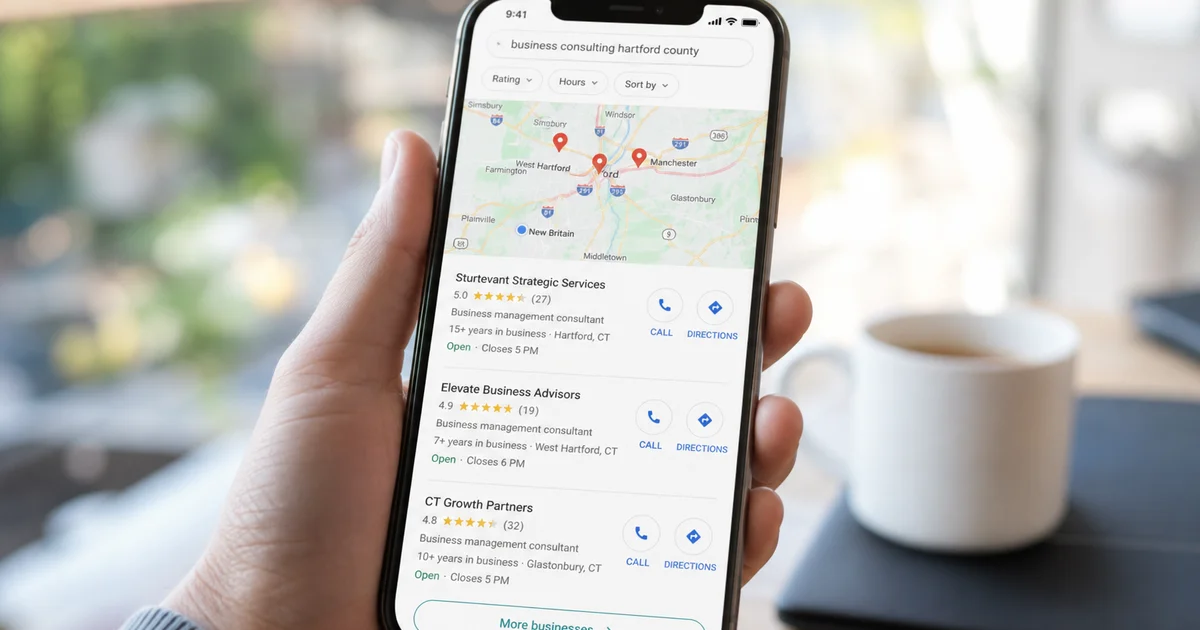
We often see local companies pouring their entire budget into traditional website SEO while completely ignoring the actual top of the search results.
The Map Pack, also called the Local 3-Pack, displays three businesses directly under the map for local queries. Our professional service team knows this is where the ready-to-buy customers actually click.
A 2026 CTR report from First Page Sage reveals that businesses inside the Google 3-pack capture 126% more traffic than those stuck in positions four through ten. We will walk through exactly how to rank in Google Map Pack search results, prioritizing the signals that control these placements and showing you how to respond practically.
The 3 Things Google Actually Measures
Google’s own documentation clearly outlines three foundational local ranking factors. We build every local campaign around these core pillars. According to the 2026 Whitespark Local Search Ranking Factors report, Google Business Profile signals now account for 32% of your total map pack ranking influence.
1. Relevance
Relevance simply measures how well your business matches what the searcher is typing into Google. Our primary focus here involves optimizing your Google Business Profile categories, business description, and service lists. Matching the specific words on your website to the user’s search intent is equally critical.
2. Distance
Google heavily weights proximity, calculating exactly how close your business is to the person searching. We cannot change your physical US street address to manipulate this factor. Strong relevance and prominence signals can compensate for moderate distance disadvantages.
3. Prominence
Prominence evaluates whether your business is well-known, highly reviewed, and trusted across the web. Our team improves this metric by securing quality reviews, building citations, and strengthening your on-page SEO. Most of your controllable work lives in relevance and prominence, which dictate your local 3-pack ranking.
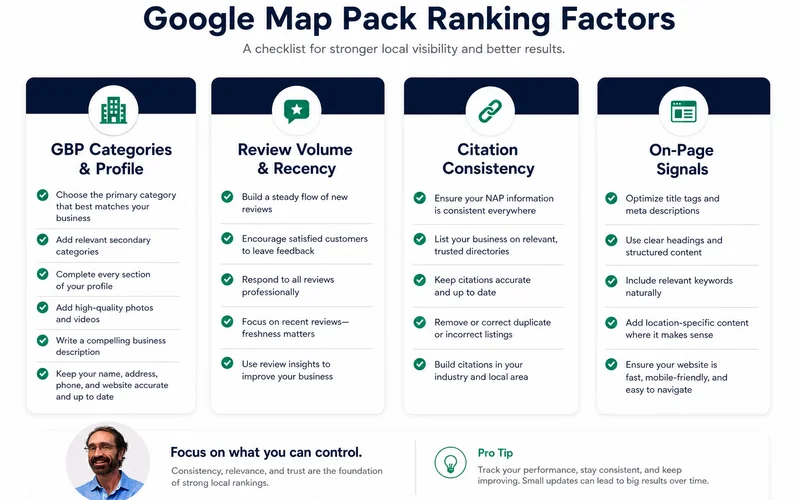
The Highest-Impact Levers for How to Rank in Google Map Pack
We constantly audit local profiles and find the same massive opportunities left untouched. Addressing these elements in the correct order provides the fastest path to visibility.
1. Primary GBP Category (The #1 Killer or Hero)
Your primary category is the single most powerful signal for what your business does. We see companies become completely invisible for valuable searches simply because they selected a generic label. Google offers over 4,000 different categories for US businesses.
Our recommendation is to immediately test your profile against the top three Map Pack competitors for your target keyword. If a highly specific primary category is used by competitors, you must update yours to match if you want to rank in Google Maps.
2. Profile Completeness (Easy Wins)
Every single accurately filled field on your profile increases consumer trust and Google’s confidence. We ensure our clients utilize all nine available secondary category slots to capture related searches. SeoProfy’s 2026 data shows that a fully verified and complete profile averages around 200 interactions per month.
A fully optimized presence requires:
- Your real, legal business name without keyword stuffing.
- An accurate primary category alongside up to nine secondary categories.
- A complete services list with descriptive text.
- Accurate regular hours and special holiday hours.
- Over 20 high-quality photos covering the interior, exterior, and team.
- A Q&A section seeded with common customer questions.
- Relevant attributes covering accessibility and payment options.
Getting a profile past the standard 50% completion mark moves Map Pack rankings within weeks. Our teams treat this as the foundation of any local campaign.
3. Reviews (Top-3 Signal)
Reviews function as a massive trust signal for both the algorithm and your potential buyers. We prioritize steady review generation over massive, unnatural bursts. Recent 2026 local search statistics show that 75% of consumers always read reviews before visiting a location.
Google evaluates your reputation based on several distinct factors:
- Volume: Having a higher total count than your local competitors.
- Recency: Consistent, fresh reviews matter far more than old ones.
- Response coverage: Replying to every single review within a few days.
- Keywords: Natural mentions of specific services help your long-tail ranking.
Our rule of thumb for competitive US markets is to target the top 30% of review counts in your specific category and zip code.
4. NAP Consistency (Quiet but Critical)
Your Name, Address, and Phone number must remain perfectly identical across the entire web. We find that inconsistencies across platforms quietly erode Google’s trust in your location data. Search engines pull your information from Apple Business Connect, Yelp, Bing Places, Nextdoor, and industry directories.
Our standard practice involves running a comprehensive citation audit annually using tools like BrightLocal or Whitespark. Fixing mismatches across the top 50 directories protects your foundation.
5. Citations (Foundation, Not Fireworks)
Citations are simply mentions of your business on authoritative web directories. We always prioritize directory quality over sheer quantity. Spammy services offering thousands of citations for a low price will often hurt your visibility.
Our local experts focus heavily on the Better Business Bureau, Apple Maps, Bing Places, Yelp, and Nextdoor. Industry-specific hubs like Houzz for contractors, Avvo for attorneys, or Healthgrades for doctors hold immense weight.
6. On-Page Website Signals
Your website’s technical performance and content directly feed your Map Pack ranking. We ensure that the physical location pages on your site clearly display a matching NAP.
Key on-page elements include:
- LocalBusiness schema markup with your complete address data.
- Service-area landing pages featuring unique, localized content.
- A mobile-first design that loads quickly, specifically aiming for a Largest Contentful Paint under 2.5 seconds.
- Strategic internal linking between your primary service and location pages.
Our technical audits frequently reveal that a slow, confusing mobile site will actively drag down a strong map listing.
7. Posts, Photos, and Activity
A profile that receives weekly updates significantly outperforms a dormant listing. We use activity signals to prove to Google that a business is currently operating and engaged. Posting one helpful update per week is sufficient to maintain this signal.
Our content managers also upload five to ten fresh photos every month to keep the profile visually active. These simple actions continuously feed your overall search visibility.
What Most Businesses Do Wrong
We audit hundreds of local profiles each year and constantly spot the same structural errors. Fixing these common mistakes provides an immediate advantage over lazy competitors. Our analysts have identified three specific patterns that actively suppress local visibility.
| The Common Mistake | The Immediate Impact | The Practical Fix |
|---|---|---|
| Wrong Primary Category | You become invisible for your most profitable, specific search terms. | Audit top-ranking competitors and update your primary category to match their specific classification. |
| Dormant Profile | A lack of posts and photos for six months makes the business look abandoned to Google. | Implement a simple schedule to upload two photos and publish one update every single week. |
| Review Starvation | Earning only two reviews a quarter prevents you from building the required prominence signal. | Build an automated text or email workflow to request reviews from every customer upon job completion. |
These fundamental errors are completely within your control to fix today. We consider these adjustments mandatory before spending money on any external advertising.
How Fast Movement Happens
Consistency is the single biggest factor in predicting ranking timelines. We establish clear expectations with clients because local SEO is never an overnight process. For a typical US small business executing the right steps, the timeline looks like this:
- Weeks 1-4: Completing the GBP profile and fixing NAP consistency creates the first minor ranking shifts.
- Months 2-3: Dialing in the exact primary category and securing fresh reviews begins to move competitive terms.
- Months 4-6: The compounding effects of consistent activity and prominence signals start to solidify your position.
- Months 6-12: You achieve strong, stable Map Pack visibility for your most valuable primary categories.
We warn businesses that if no movement occurs after three months of solid work, a severe structural issue exists. This usually indicates a hidden profile suspension or a fundamentally incorrect category choice.
The Minimum Viable Map Pack Program
Executing this strategy yourself requires a dedicated monthly routine. We recommend treating this checklist as a non-negotiable operational task.
If you handle your own marketing, commit to these baseline monthly actions:
- Publish one new update or post to your profile every week.
- Upload at least five fresh, high-quality photos per month.
- Send five or more targeted review requests weekly to recent, happy customers.
- Respond professionally to every new review within three days.
- Conduct a quarterly audit of your categories and competitor benchmarks.
Our team knows that consistency is difficult for busy owners to maintain. If you prefer having professionals handle this daily workload, you can explore the GBP optimization service that we run. We provide transparent, month-to-month reporting entirely focused on teaching you how to rank in Google Map Pack placements and driving real calls.
Frequently Asked Questions
How fast can I move into the Map Pack?
If you're nearby in ranking now: 4-8 weeks. If you're invisible: 3-6 months of consistent work. The closer you start to the top 3, the faster smaller signals move you up. Starting from page 2+, the climb is steeper.
Does my physical address matter for Map Pack ranking?
Yes — proximity to the searcher is a major signal. You'll rank better for searches happening near your address, weaker farther out. Service-area businesses can extend reach with strong on-page signals.
Should I change my business name to include keywords?
No — keyword stuffing the business name violates Google's policy and risks suspension. Use your real registered business name only. Long-term, real businesses with clean profiles always outperform keyword-stuffed names.
Related Service
Learn more about Google Business Profile Optimization
See how Fly Spectra delivers google business profile optimization for Connecticut small businesses — flat-fee, fast, and direct with the owner.
Explore Google Business Profile OptimizationRelated Guides
What a Google Business Profile Audit Checks (And What You Get)
A real GBP audit checks 40+ signals: profile completeness, category fit, NAP citations, reviews, competitor benchmarks. What you get and what it costs.
What Is a Google Business Profile and Why It Matters
Your GBP is the free local visibility asset most CT businesses underuse. What it is, how it feeds the Map Pack, and what a complete profile includes.
Have a question this guide didn't answer?
Send a quick message. Joseph replies personally, usually the same day.